For years, the warehousing conversation in India has orbited the same metros—Mumbai, Delhi-NCR, and Bengaluru. But your order data is telling a different story. A growing majority of online orders now originate from and ship to Tier 2 and Tier 3 cities like Jaipur, Coimbatore, Lucknow, and Surat—and if your fulfillment footprint still hugs the big four, you are paying more to serve customers slower.
This article maps where that demand is actually landing, at a city-corridor level competitors gloss over. You will get named emerging warehousing corridors, land and rental cost signals in INR, consumption indicators worth tracking, and a practical framework for deciding where to build or lease next—so your next facility follows the demand instead of chasing it.
The Tier 2 & Tier 3 Demand Shift: What the 60% Really Means
India’s consumption map has quietly redrawn itself. Today, roughly 60% of online purchases originate from Tier 2 and Tier 3 cities—places like Coimbatore, Lucknow, Indore, Rajkot, and Vijayawada that were once treated as delivery endpoints, not demand centers (JLL). This is not a temporary e-commerce blip; it is a structural shift in where India spends, and it is rewiring warehouse location strategy from the ground up.
Why the number matters
For a decade, the warehousing industry in India clustered supply around eight metro corridors—Mumbai, NCR, Bengaluru, and Chennai. When most orders shipped to those same metros, that made sense. But when the majority of demand now sits in smaller cities, servicing it from distant metro hubs means longer line-hauls, higher last-mile costs, and slower delivery promises. The 60% figure is effectively a signal to move inventory closer to the buyer.
What is driving it?
- Deeper internet and UPI penetration bringing first-time online shoppers into the fold.
- Rising disposable incomes and aspirational demand in non-metro households.
- Quick commerce and same-day expectations that only decentralized stock can fulfill.
- Category expansion—from electronics to cold chain warehousing for groceries and pharma.
This decentralization is fueling broader warehousing market growth in India, which posted 15% leasing growth in Q1 2026 (ET Supply Chain). The practical takeaway for operators planning warehouse leasing in 2026: Grade A warehousing in India demand is no longer a metro-only story. Logistics parks, smart warehousing, and warehouse automation investments now need to follow consumption into the country’s smaller cities—the subject of where to build next.
India’s Warehousing Market Size and Growth Trajectory Through 2026
The warehousing industry in India has moved from an unorganized afterthought to one of the country’s most strategically prized infrastructure assets. The scale of the shift is best read in the numbers. Leasing rose 15% in Q1 2026, outperforming a turbulent global backdrop, on the back of resurgent manufacturing and logistics demand (source). That momentum built on an extraordinary H1 2025, when the market expanded 42% year-on-year (source).
Absorption and consumption are driving demand.
Across 20 warehousing markets, combined absorption touched roughly 60 million sq ft in 2024, powered by a consumption boom in which 60% of online purchases now originate from Tier II and III cities (source). This is precisely why warehouse leasing 2026 strategies are pivoting away from the four metros toward emerging corridors.
A market on a long growth runway
The India warehousing market is expanding at a CAGR of roughly 15.7% through 2030 (source) and is projected to reach around ₹2.9 lakh crore (US$34.99 billion) by 2027 at a similar 15.64% clip (source). Longer term, total warehouse space is forecast to approach 1.2 billion sq ft, with a decisive shift toward Grade A warehousing in India as institutional capital enters (source).
The story underneath this warehousing market growth in India is qualitative too: rising appetite for smart warehousing in India, warehouse automation in India, and cold chain warehousing, supported by freight corridors and integrated logistics parks in India that are steadily reducing supply-chain friction.
Grade A Warehousing: Why Demand Is Accelerating
As consumption shifts outward—with 60% of online purchases now originating from Tier II and III cities (JLL)—occupiers are no longer satisfied with basic sheds. They want Grade A warehousing: institutionally developed, compliance-ready facilities built to precise specifications. This shift is the single biggest structural change in the warehousing industry in India.
What separates Grade A from Grade B?
Grade A assets offer higher clear heights, wider column grids, fire-safety compliance, superior flooring (FM2 standards), dock levellers, and the power backbone needed for warehouse automation in India and cold chain warehousing. Grade B facilities are typically older, unbranded, and lack the load-bearing and digital readiness modern occupiers demand.
| Feature | Grade A | Grade B |
|---|---|---|
| Clear height | 10–12 m+ | 6–8 m |
| Flooring | FM2, high load | Basic, uneven |
| Compliance & GST readiness | Full | Partial |
| Automation & IoT readiness | Built-in | Limited |
| Developer | Institutional | Fragmented |
The drivers pushing occupiers toward Grade A
Three forces are converging. First, the warehousing market growth in India is robust—leasing rose 15% in Q1 2026 (ET Supply Chain). Second, public investment in freight corridors and integrated logistics parks in India is cutting supply-chain friction (Knight Frank). Third, e-commerce and manufacturing demand smart warehousing in India—AI-driven, multimodal, ESG-aligned hubs (Maersk).
For anyone planning warehouse leasing in 2026, the message is clear: Grade A warehousing in India is no longer a premium option—it is fast becoming the baseline occupiers expect, especially in the emerging Tier 2 and Tier 3 markets driving national fulfillment.
Emerging Corridors: Where to Build Warehouses Next
The consumption story has decisively moved inland. With 60% of online purchases now originating from Tier II and III cities, location scouting can no longer stop at the metro ring roads. The warehousing market growth in India is being written along freight corridors and emerging clusters where land is affordable and demand is rising fast.
Corridors worth watching
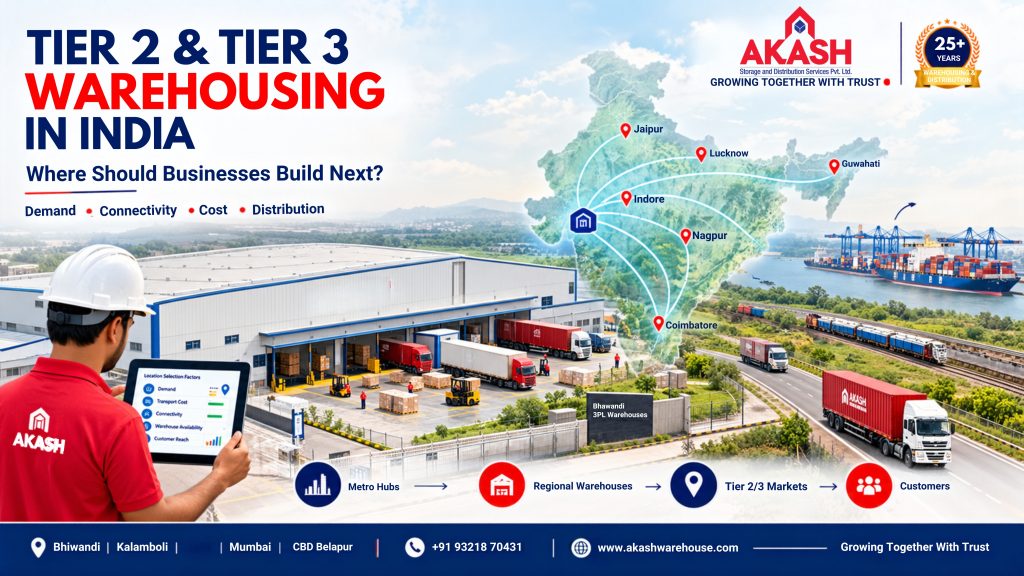
The Delhi–Mumbai Expressway and Western Dedicated Freight Corridor have unlocked hubs at Jaipur, Indore, and Nagpur. The eastern DFC feeds Lucknow and Patna, while the Chennai–Bengaluru–Hosur belt anchors southern demand. Sustained public investment in freight corridors and integrated logistics parks is reducing logistics friction—precisely the tailwind Grade A warehousing India developers are chasing.
| Emerging Hub | Corridor Link | Land Cost Signal | Demand Driver |
|---|---|---|---|
| Indore | Delhi–Mumbai Expressway | Low–Moderate | E-commerce, FMCG |
| Lucknow | Eastern DFC | Low | Consumption, quick-commerce |
| Coimbatore | Chennai–Bengaluru belt | Moderate | Manufacturing, cold chain |
| Guwahati | Northeast gateway | Low | Distribution, agri |
| Nagpur | DME / MIHAN | Low–Moderate | Multimodal automation |
Reading the signals
Tier 2/3 land trades at a fraction of Mumbai or Bengaluru rates, making these corridors ideal for smart warehousing India investments where automation payback is quicker. Cold chain warehousing is expanding rapidly in agri-rich pockets like Coimbatore and Nashik, driven by pharma and fresh-produce demand. With leasing up 15% in Q1 2026, early movers into logistics parks in India along these corridors will secure the best land basis ahead of the warehouse leasing 2026 surge—before rising development costs narrow the window.
Automation and Smart Warehousing Transforming Indian Operations
As fulfillment shifts toward Tier 2 and Tier 3 cities, the warehousing industry in India is racing to make dispersed operations efficient. The answer is technology. With leasing up 15% in Q1 2026 (source) and demand concentrated in Grade A warehousing in India, operators are deploying automation to offset rising land and labor costs across emerging corridors.
AI and smart warehousing systems
Warehouse management platforms now use AI for demand forecasting, slotting, and route optimization, while automated storage-and-retrieval systems, conveyor sortation, and robotics compress order cycle times. Smart warehousing in India—driven by IoT sensors, real-time inventory visibility, and predictive maintenance—is central to 2026 fulfillment networks (source). This lets a Nagpur or Coimbatore facility match metro-grade service levels.
Cold chain adoption
Cold chain warehousing is expanding fast as pharma, dairy, and quick-commerce grocery reach smaller cities. Temperature-controlled Grade A stock, backed by freight corridors and integrated logistics parks in India, is reducing spoilage and widening the deliverable catchment for perishables.
Reshaping labor needs
Warehouse automation in India is not eliminating jobs so much as changing them—from manual picking to supervising equipment, managing data, and running control towers. Skilled roles in systems operation and analytics are the new demand.
For occupiers planning warehouse leasing in 2026, the takeaway is clear: the warehousing market growth in India increasingly favors tech-enabled, automation-ready facilities. When choosing where to build next, prioritize sites that can support power-intensive cold chains and smart systems—not just cheap land.
Warehousing Trends 2026 and How to Act on Them
The forces reshaping the warehousing industry in India are no longer speculative—they are quantifiable. Leasing grew 15% in Q1 2026, extending a run that saw the market rise 42% year-on-year in H1 2025, according to a source. With 60% of online orders originating in Tier 2 and 3 cities, developers and occupiers must translate warehousing market growth in India into concrete decisions. Here is how.
1. Build Grade A where consumption is migrating
Prioritise Grade A warehousing India stock near emerging corridors—Lucknow, Coimbatore, Guwahati, Indore—rather than saturating metro fringes. Anchor site selection to freight corridors and integrated logistics parks India, where multimodal integration cuts first-mile friction source.
2. Design for automation and ESG from day one
Retrofitting is costly. Specify smart warehousing India features—AS/RS readiness, energy-efficient HVAC, rooftop solar, and rainwater harvesting—at the drawing-board stage. Warehouse automation India and sustainability are now dual expectations from global occupiers source, not premium add-ons.
3. Plan cold chain and skills in parallel
Rising demand for pharma, F&B and quick-commerce makes cold chain warehousing a growth segment—but power reliability and GST-compliant design determine viability. Simultaneously, invest in trained supervisors and system operators; automation without skilled teams stalls.
4. Time your leasing strategy
With absorption near record highs, secure warehouse leasing 2026 commitments early to lock favourable rentals before land constraints and development costs tighten supply. Occupiers should negotiate build-to-suit terms; developers should phase capex against pre-leasing.
The action is clear: follow consumption into smaller cities, build green and automated, and secure capacity now—before the next demand wave prices you out.
Conclusion
The shift is clear: demand is no longer concentrated in metros, and warehousing strategy must follow the customer. With the majority of online orders now flowing to and from Tier 2 and Tier 3 cities, proximity to consumers in places like Jaipur, Coimbatore, Lucknow, and Surat is becoming the deciding factor in faster deliveries, lower freight costs, and healthier margins. Building distributed capacity closer to these emerging demand centres — while weighing land costs, GST-efficient placement, and reliable logistics corridors — is how forward-looking brands stay competitive in 2026 and beyond. The businesses that map their next warehouse locations now will own the last-mile advantage tomorrow. If you’re planning your next facility, our team can help you assess the right locations.
Frequently Asked Questions
Why do 60% of online orders now ship from Tier 2 and Tier 3 cities?
Rising internet penetration, affordable smartphones and growing consumption have made smaller cities major demand centres. Around 60% of online purchases now originate from Tier II and III towns. To meet delivery expectations, brands are placing inventory closer to these buyers, shifting fulfilment away from only metros toward regional warehouses across India.
How big is India’s warehousing market and how fast is it growing?
India’s warehousing sector is expanding rapidly, with leasing rising 15% in Q1 2026 and the market growing 42% year-on-year in H1 2025. Total warehouse space is projected to reach roughly 1.2 billion sq ft. Analysts estimate the market will touch nearly ₹2.9 lakh crore by 2027, growing at over 15% CAGR.
What is Grade A warehousing and why is demand rising in India?
Grade A warehouses are modern, high-specification facilities with better layouts, taller clear heights, fire safety, and automation readiness. Demand is rising as e-commerce, 3PL and manufacturing tenants seek efficient, compliant spaces. Public investment in freight corridors and integrated logistics parks is accelerating the shift from fragmented, unorganised sheds to institutional-grade stock.
Which cities and regions are driving warehousing demand in India?
Established hubs like Mumbai, NCR, Bengaluru, Chennai, Pune and Kolkata continue to lead, but Tier 2 and Tier 3 cities such as Lucknow, Coimbatore, Guwahati, Jaipur and Nagpur are emerging fast. Combined absorption across 20 markets reached about 60 mn sq ft, driven by consumption booms in these smaller cities.
How is automation transforming warehousing in India?
Automation is reshaping Indian warehouses through AI-driven inventory systems, robotics, automated storage and retrieval, and smart warehouse management software. These technologies cut errors, speed up order processing and reduce labour dependence. As the smart warehousing market grows, automation is helping operators handle rising e-commerce volumes while improving accuracy and delivery times.
What are the key warehousing trends for 2026 in India?
Key 2026 trends include AI-driven autonomy, sustainability and ESG-compliant green warehouses, multimodal integration, and smart logistics hubs. Grade A demand continues rising, backed by freight corridors and integrated logistics parks. Expansion into Tier 2 and Tier 3 cities and increased institutional investment are also defining the sector’s direction this year.
How is e-commerce growth impacting India’s warehousing sector?
E-commerce is a primary demand driver, pushing brands to build distributed fulfilment networks closer to buyers. With 60% of online orders coming from smaller cities, retailers need regional warehouses for faster, cheaper delivery. This fuels leasing growth, Grade A adoption and automation investment as companies compete on speed and reliability.