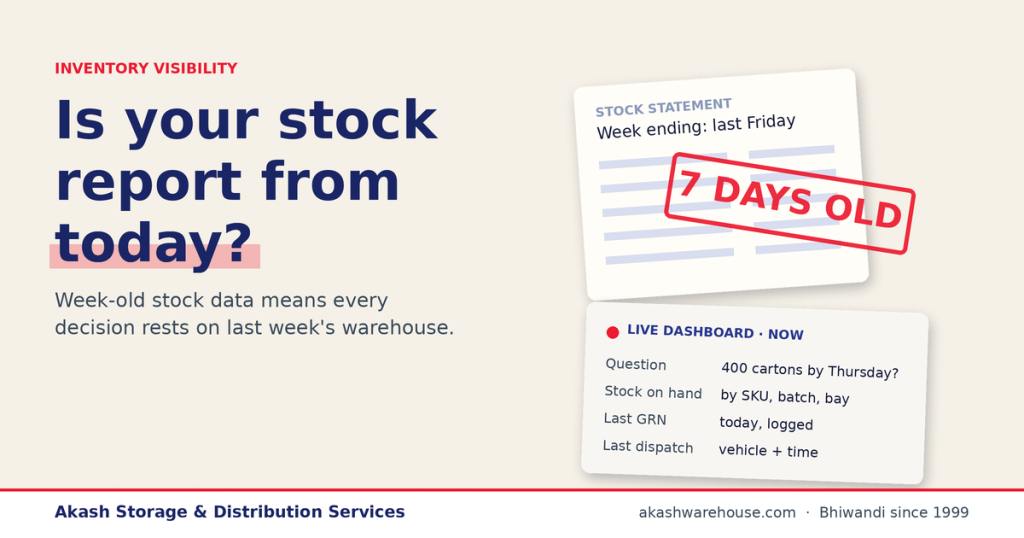
It’s 11 o’clock on a Monday morning. A customer calls and asks a simple question: can 400 cartons go out by Thursday?
Your sales head says yes, without hesitation. Your accounts team pulls up last Friday’s stock statement and isn’t so sure. Your warehouse supervisor is somewhere on the floor, counting.
Three people. Three versions of the truth. And the customer is still waiting, because nobody can give a straight answer until someone rings the warehouse.
We’ve had some version of this conversation with hundreds of businesses over the last 25 years. Almost always, the space isn’t the issue. The racks are fine. The goods are safe. What’s missing is a reliable answer to “What do we actually have right now?”
The phone call isn’t the expensive part.
The call costs you ten minutes. The decision you make without the data costs far more.
When your stock figure is a week old, every decision that rests on it inherits that week. You see it in a few familiar ways.
You overorder because nobody fully trusts what’s on the shelf. So working capital sits in cartons instead of in the bank.
Or you under-order and lose a sale you could have made.
Book stock and physical stock slowly drift apart. Nobody notices until the year-end audit, which is exactly when the gap is hardest to explain.
And when a customer disputes a delivery, the argument drags on. Nobody can say, with evidence, what left the warehouse, when, and on which vehicle.
You won’t find any of this in your P&L under a heading called “poor visibility.” It hides inside higher inventory holding, missed orders, audit adjustments, and hours of management time spent on follow-ups.
Why the weekly Excel isn’t enough
To be fair, a weekly stock statement isn’t wrong. It’s just old.
By the time it lands in your inbox, it describes a warehouse that no longer exists. Goods have come in. Orders have gone out. A batch has expired. If you dispatch every day, seven-day-old data can’t support this week’s decisions. It can only record last week’s history.
Five questions you should be able to answer without picking up the phone
Here’s a test we’d suggest to any owner or finance head. Try answering these from your desk, right now.
-
- What do I have? Quantity, batch, and location, as of this moment.
-
- What came in? Was a goods receipt note raised the day stock arrived, or will you hear about it on Friday?
-
- What went out? Every dispatch, with quantity, vehicle, and time.
-
- What should move first? Is FIFO or FEFO applied by a system, or by someone’s memory?
-
- Does the book match the shelf? Is that checked every month or discovered in March?
If even one of these needs a call, an email, or a “let me check and revert” email, you don’t have visibility. You have a reporting delay.
How we approach it at Akash
We’ve run warehouses in Bhiwandi since 1999. The lesson hasn’t changed in that time: clients don’t want more reports. They want fewer follow-ups.
So our clients get access to a live dashboard, run on our own Flow Management System (FMS) and warehouse management system. It’s the same system that tells our floor team where every SKU sits, down to the bay, zone, and rack. What you see on screen is what’s on the shelf.
In practice, that means:
-
- A physical stock count when you move in, so day one starts from a verified number.
-
- A GRN at every inward receipt, recording SKU, quantity, condition, batch, and date, shared with you before the goods are shelved.
-
- Every dispatch is logged with quantity, vehicle details, and timestamp, giving you an exportable audit trail.
-
- FIFO or FEFO enforced by the system wherever your product needs it.
-
- Daily, weekly, or monthly stock statements you can pull yourself, in Excel, or in PDF, covering opening, inward, outward, and closing stock.
-
- Monthly reconciliation, plus a sync with your ERP, TMS, or e-commerce backend if you want one.
The goal is simple. You should know your stock position before we tell you.
A two-minute test for this week
Open the most recent stock report you have and look at the date on it.
If it’s today, you’re in control. If it’s from last week, then every decision you make this week is resting on last week’s warehouse.
We’d like to hear how this plays out for you. How old is the stock data your team is working from right now, and what’s one decision it slowed down recently?
See your stock the way our clients see it.
Bring your latest stock statement to a 30-minute dashboard walkthrough. We’ll show you the same view as it looks live: stock by SKU, batch and bay, every GRN, and every dispatch with vehicle and time.
Would you rather see it in person? Book a site visit at our Bhiwandi facility, or message us on WhatsApp.
 +91 93218 70431 ·
 info@akashwarehouse.com