Introduction
Invoice delays can create more than an administrative problem for Indian warehousing, When operational data, dispatch records, billing information, and customer communication are handled through disconnected systems, invoices can take longer to prepare and verify.
For warehousing businesses, faster and more accurate billing can improve operational visibility and help teams manage cash flow more effectively.
This is where AI-native business operating systems can play a role.
Instead of relying on separate tools and manual follow-ups, businesses can connect operational data and automate selected workflows across warehousing, inventory, dispatch, and invoicing.
Why Invoice Delays Happen in Warehousing
Invoice delays can occur when information is spread across multiple processes.
Common causes include:
- Manual data entry
- Delayed dispatch updates
- Missing documentation
- Differences between inventory and operational records
- Manual invoice preparation
- Approval bottlenecks
- Poor communication between teams
- Lack of real-time operational visibility
For an SMB, even small delays can create additional follow-ups for the operations, accounts, and customer-service teams.
What Is an AI-Native Business Operating System?
An AI-native business operating system uses AI and connected business data as part of everyday workflows rather than treating AI as a separate tool.
For a warehousing business, such a system could connect information from areas such as
- Inventory
- Receiving
- Dispatch
- Orders
- Billing
- Customer communication
- Documents
- Operational reports
The objective is to create a more connected flow of information so teams can identify exceptions, automate repetitive activities, and make decisions using current operational data.
Important: Avoid presenting AI-native systems as automatically eliminating invoice delays. The actual benefit depends on data quality, system integration, workflow design, and human oversight.
How AI Can Help Reduce Invoice Delays
1. Automated Invoice Generation
Once predefined operational conditions are completed, an integrated system can trigger invoice-generation workflows.
For example:
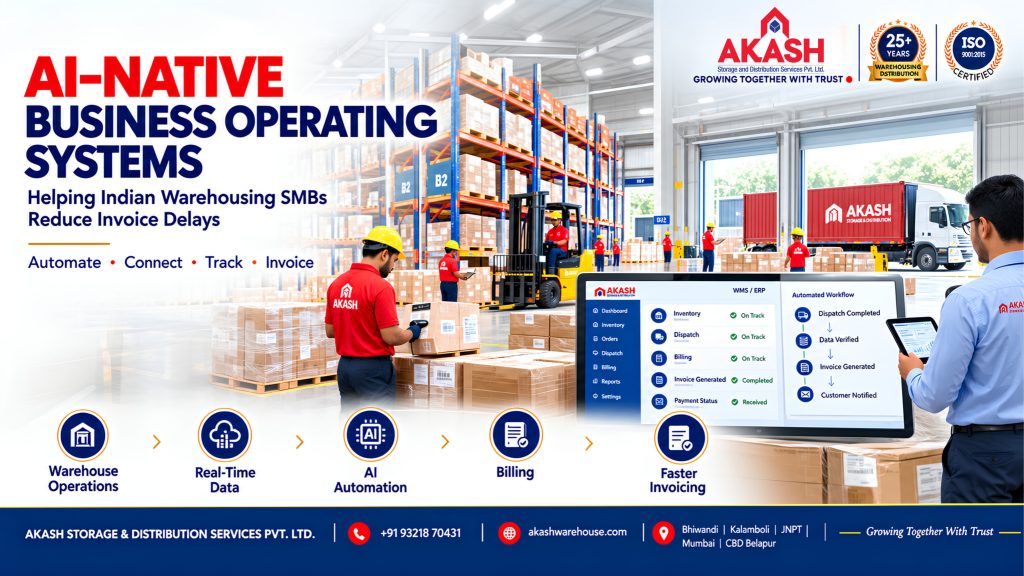
Dispatch completed → Operational data verified → Billing information generated → Invoice approval → Invoice sent
This can reduce repetitive manual data entry and follow-up.
2. Real-Time Operational Visibility
Connecting inventory, order, and dispatch information can help accounts and operations teams work from the same information.
This can make it easier to identify:
- Pending dispatches
- Missing information
- Unbilled transactions
- Billing exceptions
- Delayed approvals
3. Smart Alerts and Exception Management
AI-assisted systems can identify unusual or incomplete information and notify the relevant team.
Examples include:
- Missing billing information
- Mismatch between operational records
- Pending approvals
- Unusual transaction patterns
- Invoices waiting for action
The important point is that AI should help teams identify exceptions, rather than simply generating more automated notifications.
4. Connected Communication
When operations, accounts, and customer-service teams work from connected information, fewer manual follow-ups may be required.
A centralized system can provide a common view of:
Order → Inventory → Dispatch → Billing → Customer
What Indian Warehousing SMBs Should Consider Before Adopting AI
AI implementation should start with the business process, not the technology.
Before selecting a solution, businesses should assess:
1. Current workflow
Map how information moves from receiving and storage through order processing, dispatch, and billing.
2. Data quality
AI cannot reliably automate a process when the underlying data is incomplete or inconsistent.
3. Existing systems
Check whether the solution can integrate with the company’s existing accounting software, WMS, ERP, and other operational systems.
4. Human approval
Financial transactions should have appropriate review and approval controls.
5. Scalability
The system should support increasing customers, transactions, warehouse locations, and operational complexity.
A Practical Implementation Approach
Indian warehousing SMBs do not necessarily need to automate everything at once.
A practical approach can be:
Step 1—Map the current billing process.
Identify where delays occur.
Step 2—Identify repetitive tasks
Find activities that involve repeated data entry, checking, or follow-up.
Step 3—Connect operational data
Bring relevant inventory, order, dispatch, and billing information together.
Step 4—Automate selected workflows
Start with clearly defined processes such as invoice preparation, alerts, or document collection.
Step 5—Add AI-assisted exception detection
Use AI where it can help identify missing information, unusual transactions, or workflow bottlenecks.
Step 6—Monitor results
Track invoice turnaround time, pending invoices, exception rates, and manual interventions.
Measuring the Impact of AI on Warehouse Billing
Instead of simply asking whether AI has been implemented, businesses should measure operational results.
Useful KPIs include:
- Invoice turnaround time
- Number of pending invoices
- Invoice error rate
- Manual billing interventions
- Dispatch-to-invoice time
- Approval turnaround time
- Billing-related customer queries
- Percentage of invoices processed automatically
These metrics can show whether automation is actually improving the billing workflow.
The Future of AI in Indian Warehousing
AI is likely to become increasingly integrated into warehouse and logistics workflows.
For SMBs, the opportunity is not simply to add an AI chatbot or automation tool. The larger opportunity is to connect operational data and use AI where it can reduce repetitive work, highlight exceptions, and provide better visibility.
The strongest implementations will still depend on clean data, well-defined processes, appropriate controls, and trained teams.
FAQs
What is an AI-native business operating system?
An AI-native business operating system is a business platform designed to use AI and connected operational data as part of everyday workflows, decision-making, and automation.
Can AI automate warehouse invoicing?
AI-enabled systems can automate parts of the invoicing workflow, such as collecting information, identifying missing data, triggering invoice-generation processes, and sending alerts. The exact level of automation depends on the system and business process.
How can AI reduce invoice delays?
AI can help identify missing information, automate repetitive tasks, connect operational data, and alert teams about pending or exceptional transactions.
Is AI suitable for small and medium-sized warehouses?
It can be, particularly when the solution is scalable and addresses specific operational problems. SMBs should evaluate implementation costs, integrations, data quality, and the complexity of their existing workflows.
Does AI replace warehouse and accounts teams?
AI automation is generally better viewed as a way to support teams by reducing repetitive work and highlighting exceptions. Human review and appropriate financial controls remain important.