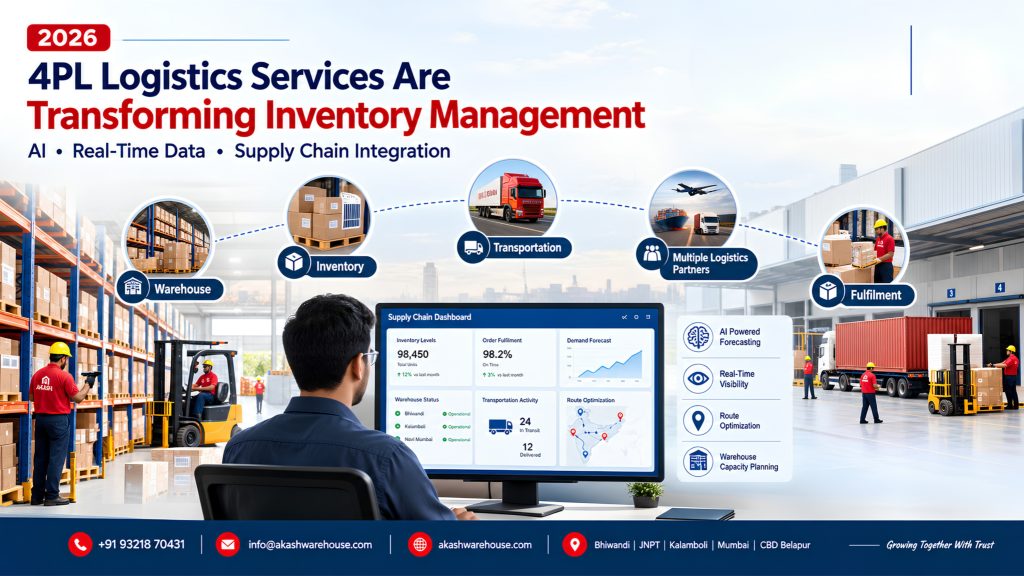
Inventory management is a critical yet complex challenge for logistics providers like Akash Warehouse Co, where the balance between stock availability and cost efficiency can make or break operational performance. As demand patterns shift and supply chains grow more intricate, traditional methods are struggling to keep pace. The need for smarter, more agile solutions has never been greater. This article explores how 4PL logistics services are redefining inventory management in 2026, with a focus on real-time data integration and AI-driven forecasting. By leveraging these advanced tools, 4PL providers are not just streamlining operations—they’re transforming them, offering a strategic edge that goes beyond conventional logistics outsourcing.
Understanding 4PL Warehousing: A Definition and Overview
Fourth-Party Logistics (4PL) warehousing represents a strategic evolution in supply chain management, offering businesses a comprehensive solution to complex logistics challenges. A 4PL provider acts as a single point of contact, integrating and managing an entire supply chain on behalf of a company. This includes overseeing transportation, warehousing, inventory, and fulfillment, with the goal of enhancing visibility, efficiency, and long-term cost savings.
4PL vs 3PL: Key Differences
Unlike third-party logistics (3PL) providers, which typically handle one or more logistics functions, 4PLs take a more holistic approach. They manage multiple logistics providers, systems, carriers, and warehouses, creating a unified and optimized supply chain. This distinction is critical for businesses seeking to streamline operations and reduce fragmentation sources.
Benefits of 4PL Logistics
4PL logistics services offer significant advantages, including improved inventory management, reduced operational costs, and enhanced supply chain visibility. By leveraging advanced technologies such as AI and automation, 4PLs enable real-time tracking and predictive analytics, which are becoming increasingly common by 2026, according to the source.
4PL vs. 3PL: Key Differences in Logistics Services
Understanding the distinction between 4PL and 3PL is critical for businesses aiming to optimize their supply chain operations. While both models offer logistics support, their operational scope and strategic roles differ significantly.
Operational Scope
A 3PL provider typically manages one or more specific logistics functions, such as warehousing, transportation, or inventory management. In contrast, a 4PL acts as a strategic supply chain integrator, overseeing multiple logistics providers, systems, carriers, and distribution functions to enhance visibility and efficiency.
Strategic Role
4PL services are designed to offer end-to-end supply chain management, including 4PL warehouse integration and 4PL inventory management, which are essential for balancing cost and customer service sources. This contrasts with 3PLs, which often focus on execution rather than strategic oversight.
As the 4PL market is projected to grow from USD 91.5 billion in 2026 to USD 163.7 billion in 2035 at a CAGR of 6.7% (source), businesses are increasingly recognizing the value of 4PL logistics trends in 2026, such as AI-supported forecasting and automation, which are becoming more commonplace (source).
The Benefits of 4PL Logistics Services for Businesses
As businesses navigate the complexities of modern supply chains, Fourth-Party Logistics (4PL) services are emerging as a transformative solution. A 4PL provider manages the broader supply chain on behalf of a business, overseeing multiple logistics providers, systems, carriers, warehouses, and distribution functions to improve visibility, efficiency, and long-term performance. This holistic approach contrasts with traditional Third-Party Logistics (3PL) services, which typically handle only one part of the logistics process source.
Cost Efficiency and Scalability
Adopting 4PL logistics services can lead to significant cost savings by consolidating fragmented logistics operations. Research indicates that businesses can reduce logistics costs by up to 20% by consolidating partners and eliminating redundant processes [source]. Additionally, 4PLs leverage advanced technologies such as AI and automation to optimize warehouse capacity planning and route optimization, which are expected to become more commonplace by 2026 [source].
Enhanced Supply Chain Visibility
4PL logistics services offer real-time visibility into inventory across the supply chain, enabling businesses to make data-driven decisions. This is particularly valuable in 4PL inventory management, where 4PL providers use integrated systems to optimize inventory levels, reduce stockouts, and minimize holding costs. As the 4PL market is projected to grow from USD 91.5 billion in 2026 to USD 163.7 billion in 2035 at a CAGR of 6.7% (source), the demand for these services will continue to rise.
How 4PL Is Expected to Impact Supply Chain Management in 2026
As supply chains become increasingly complex, Fourth-Party Logistics (4PL) is poised to redefine inventory management and logistics operations in 2026. A 4PL provider manages the broader supply chain on behalf of a business, overseeing multiple logistics providers, systems, carriers, and warehouses to improve visibility, efficiency, and long-term cost savings. This contrasts with traditional Third-Party Logistics (3PL), which typically handles only one part of the logistics process source.
One of the key benefits of 4PL logistics is its ability to integrate AI and real-time data into inventory management. By 2026, AI-supported forecasting, route optimization, and warehouse capacity planning will become more commonplace, enabling businesses to reduce stockouts, minimize holding costs, and enhance customer service. This integration is critical for 4PL warehouse services, which provide end-to-end supply chain visibility and support strategic inventory management sources.
With the 4PL market projected to grow from USD 91.5 billion in 2026 to USD 163.7 billion by 2035 at a CAGR of 6.7% (source), businesses like Akash Warehouse Co are well-positioned to leverage these trends and deliver smarter, more connected logistics solutions. The future of supply chain management in 2026 is increasingly defined by the strategic role of 4PL in driving innovation and efficiency.
Main Functions of a 4PL Warehouse Provider
A 4PL warehouse provider, or fourth-party logistics, is a strategic partner that integrates and manages an entire supply chain on behalf of a business. Unlike traditional third-party logistics (3PL) providers, which handle specific logistics functions, 4PLs oversee multiple logistics providers, systems, carriers, warehouses, and distribution functions to improve visibility, efficiency, and long-term performance.
Inventory Management
One of the core functions of a 4PL warehouse provider is efficient inventory management. They leverage advanced inventory management systems and techniques to optimize inventory levels, reduce stockouts, and minimize holding costs. Real-time visibility into inventory across the supply chain is also a key benefit, enabling businesses to make data-driven decisions.
Supply Chain Integration
A 4PL provider acts as a strategic supply chain integrator, overseeing transportation, warehousing, inventory, and fulfillment. This integration ensures seamless coordination between different logistics partners, enhancing overall supply chain resilience and responsiveness.
Technology and Automation
With the rise of AI and automation in 2026, 4PLs are increasingly adopting smart technologies to optimize operations. These include AI-supported forecasting, route optimization, and warehouse capacity planning, which help businesses stay competitive in a rapidly evolving market source.
4PL Logistics Trends for 2026: A Look at the Future
As the logistics landscape evolves, 4PL logistics trends for 2026 are reshaping how businesses manage their supply chains. Fourth-Party Logistics (4PL) is no longer just an advanced model—it’s becoming the standard for companies seeking integrated, scalable, and intelligent supply chain solutions. A 4PL provider manages the broader supply chain on behalf of a business, overseeing multiple logistics providers, systems, carriers, warehouses, and distribution functions to improve visibility, efficiency, and long-term performance.
AI and Automation in Warehouse Operations
By 2026, AI-supported forecasting, route optimization, and warehouse capacity planning will become more commonplace, enabling smarter, more connected operations across the supply chain source. These technologies are driving the rise of automated warehouses, which enhance all the advantages of a logistics provider and prove to be a scalable investment source.
With 4PL warehouse integration, businesses can achieve real-time visibility into inventory across the supply chain, reducing stockouts and minimizing holding costs. This level of control and insight is a key benefit of 4PL logistics, positioning it as a critical component of modern inventory management and supply chain management strategies.
Implementing 4PL Logistics: A Step-by-Step Guide
Integrating 4PL logistics services can significantly enhance inventory management and supply chain efficiency. A 4PL, or fourth-party logistics provider, manages the broader supply chain on behalf of a business, overseeing multiple logistics providers, systems, carriers, and warehouses. This contrasts with 3PLs, which typically handle only one part of the logistics process source.
Step 1: Assess Your Current Supply Chain
Begin by evaluating your existing logistics operations. Identify pain points such as fragmented processes, inefficiencies in inventory management, and lack of real-time visibility. These insights will help determine the need for a 4PL partner source.
Step 2: Define Strategic Objectives
Clearly outline your goals, such as cost reduction, improved inventory accuracy, or enhanced customer service. A 4PL can offer benefits like AI-supported forecasting and route optimization, which are becoming more common by 2026, according to the source.
Step 3: Select the Right 4PL Partner
Choose a 4PL that aligns with your strategic goals and has experience in your industry. Look for providers that offer end-to-end supply chain management, including 4PL warehouse integration and inventory management sources.
Conclusion
In 2026, 4PL logistics services are redefining inventory management by offering end-to-end solutions that integrate supply chain visibility, automation, and predictive analytics sources. For Akash Warehouse Co, adopting a 4PL model can lead to improved efficiency, reduced costs, and better customer satisfaction. By leveraging advanced data analytics and real-time tracking, Akash can optimize stock levels, reduce waste, and respond faster to market changes. To stay competitive, Akash should evaluate 4PL providers that align with its operational goals and technological capabilities. Engaging with a 4PL partner can unlock new efficiencies and position Akash for long-term growth in the evolving logistics landscape.
Frequently Asked Questions
What is 4PL warehousing, and how does it differ from 3PL?
4PL warehousing involves a single provider managing the entire supply chain, including transportation, inventory, and fulfillment. Unlike 3PL, which handles specific logistics functions, 4PL offers strategic integration and oversight of multiple logistics providers, enhancing efficiency and visibility.
What are the key benefits of using 4PL logistics services?
4PL logistics services offer improved efficiency, cost savings, and enhanced supply chain visibility. They integrate multiple providers, optimize inventory management, and leverage advanced technologies like AI and automation to streamline operations.
How is 4PL expected to impact supply chain management in 2026?
In 2026, 4PL is expected to transform supply chain management by enabling smarter, more connected operations. With AI and automation, 4PL will enhance visibility, reduce costs, and support scalability, meeting the growing demands of e-commerce and global markets.
What are the main functions of a 4PL warehouse provider?
A 4PL warehouse provider manages the entire supply chain, including warehousing, transportation, inventory, and fulfillment. They integrate multiple logistics providers, optimize operations, and offer real-time visibility to enhance efficiency and customer service.
What is the projected growth of the 4PL market in 2026?
The 4PL market is projected to grow from USD 91.5 billion in 2026 to USD 163.7 billion by 2035, with a CAGR of 6.7%. This growth reflects increasing demand for integrated, technology-driven logistics solutions in a rapidly evolving supply chain landscape.
How does 4PL contribute to inventory management?
4PL contributes to inventory management by leveraging advanced systems and techniques to optimize inventory levels, reduce stockouts, and minimize holding costs. They provide real-time visibility across the supply chain, ensuring efficient stock availability and cost control.
What role does AI play in 4PL logistics services?
AI plays a crucial role in 4PL logistics by enabling forecasting, route optimization, and process automation. These technologies enhance decision-making, improve operational efficiency, and support scalable, data-driven supply chain management in 2026.