Introduction
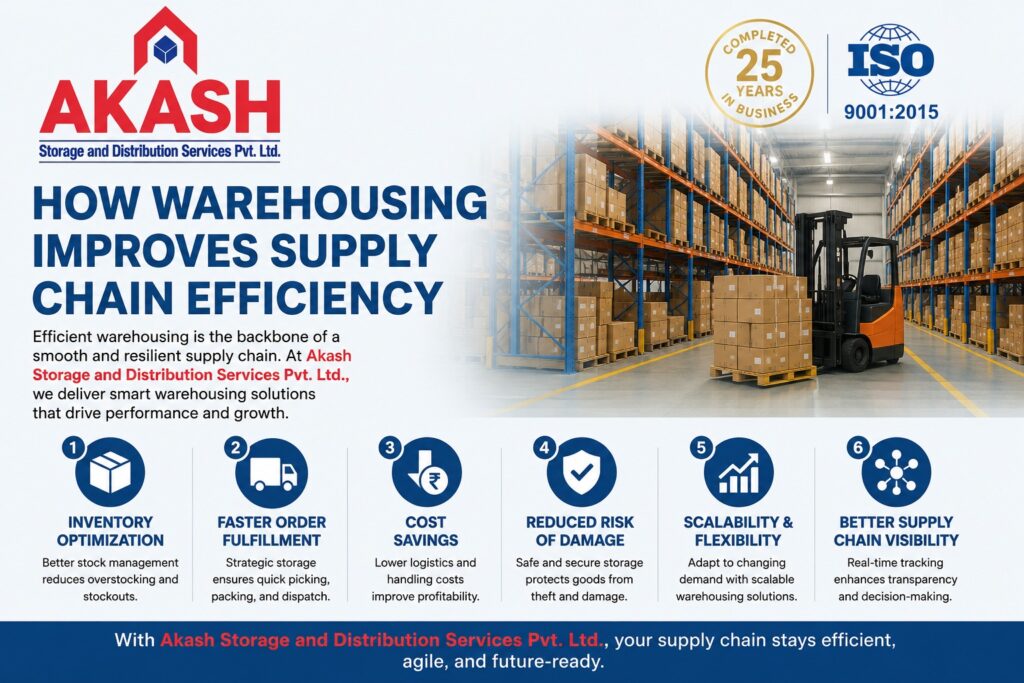
In today’s competitive business environment, supply chain efficiency plays a critical role in determining business success. Companies must ensure products move smoothly from manufacturers to customers while maintaining accuracy, speed, and cost-effectiveness.
One of the most important components of an efficient supply chain is warehousing. While many businesses view warehouses simply as storage facilities, modern warehousing serves a much larger purpose. Warehouses act as strategic hubs that support inventory management, order fulfillment, distribution, and overall supply chain performance.
Efficient warehousing helps businesses reduce costs, improve customer satisfaction, and respond quickly to changing market demands. Whether a company operates in manufacturing, retail, e-commerce, pharmaceuticals, FMCG, or distribution, effective warehousing is essential for maintaining a competitive advantage.
Understanding how warehousing contributes to supply chain efficiency can help businesses make better decisions and improve operational performance.
Understanding Supply Chain Efficiency
Supply chain efficiency refers to the ability of a business to deliver products to customers quickly, accurately, and cost-effectively.
An efficient supply chain ensures:
- Products are available when needed
- Inventory levels are optimized
- Transportation costs are controlled
- Orders are fulfilled accurately
- Customers receive products on time
When supply chain operations run smoothly, businesses experience improved profitability, stronger customer relationships, and sustainable growth.
Warehousing is one of the key factors that influence supply chain efficiency.
The Strategic Role of Warehousing
Modern warehouses are much more than storage locations.
Today’s warehousing facilities support:
- Inventory management
- Product handling
- Order processing
- Packaging
- Distribution
- Transportation coordination
By serving as central points within the supply chain, warehouses help businesses manage inventory effectively while ensuring products are readily available for customers.
A well-managed warehouse acts as a bridge between suppliers, manufacturers, distributors, and end customers.
1. Improves Inventory Visibility
One of the biggest advantages of effective warehousing is improved inventory visibility.
Inventory visibility allows businesses to:
- Monitor stock levels in real time
- Track inventory movement
- Identify slow-moving products
- Prevent stock shortages
Without accurate inventory visibility, businesses may experience stockouts, overstocking, and fulfillment delays.
Modern warehouse management systems provide real-time access to inventory data, enabling better decision-making and improved operational control.
When businesses know exactly what inventory they have, they can respond more effectively to customer demand.
2. Reduces Inventory Costs
Inventory carrying costs can significantly impact profitability.
These costs include:
- Storage expenses
- Insurance
- Product obsolescence
- Inventory depreciation
Efficient warehousing helps businesses optimize inventory levels and reduce unnecessary carrying costs.
By implementing proper inventory management practices, companies can:
- Maintain optimal stock levels
- Reduce excess inventory
- Improve inventory turnover
- Minimize waste
Lower inventory costs contribute directly to improved supply chain efficiency and financial performance.
3. Enhances Order Fulfillment Speed
Customers expect fast and reliable deliveries.
Warehouse operations directly affect order fulfillment performance.
Efficient warehouses support:
- Faster picking and packing
- Reduced processing times
- Accurate order preparation
- Quick shipment dispatch
When products are stored systematically and inventory systems provide real-time visibility, warehouse teams can process orders more efficiently.
Faster fulfillment improves customer satisfaction and strengthens brand reputation.
4. Improves Order Accuracy
Order accuracy is essential for maintaining customer trust.
Incorrect shipments can result in:
- Customer complaints
- Product returns
- Additional shipping costs
- Lost sales opportunities
Well-organized warehouses use structured processes and technology to improve order accuracy.
Tools such as:
- Barcode scanning
- RFID tracking
- Warehouse Management Systems (WMS)
help reduce human errors and ensure customers receive the correct products.
Higher order accuracy leads to better customer experiences and lower operational costs.
5. Supports Demand Fluctuations
Customer demand can change rapidly due to:
- Seasonal trends
- Promotional campaigns
- Market conditions
- Economic factors
Efficient warehousing helps businesses adapt to these fluctuations.
Warehouses provide storage capacity that allows companies to:
- Build inventory before peak seasons
- Manage demand spikes
- Maintain product availability
This flexibility improves supply chain responsiveness and reduces the risk of stock shortages.
Businesses that can quickly respond to changing demand gain a competitive advantage.
6. Facilitates Efficient Distribution
Distribution is a critical component of supply chain management.
Strategically located warehouses help businesses:
- Reduce transportation distances
- Improve delivery times
- Lower shipping costs
- Enhance regional coverage
By positioning inventory closer to customers, businesses can improve distribution efficiency and provide faster service.
Efficient distribution networks contribute to overall supply chain performance and customer satisfaction.
7. Strengthens Supply Chain Resilience
Recent global events have highlighted the importance of supply chain resilience.
Supply chain disruptions can occur due to:
- Transportation delays
- Natural disasters
- Supplier issues
- Economic uncertainty
Warehousing plays an important role in mitigating these risks.
Maintaining strategic inventory levels within warehouses helps businesses continue operations during disruptions.
A resilient supply chain allows organizations to maintain service levels even during challenging circumstances.
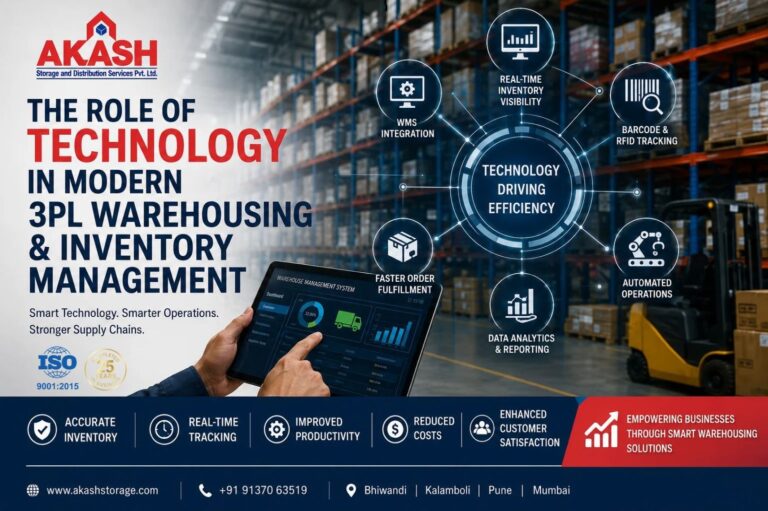
8. Supports Technology Integration
Technology is transforming modern warehousing and supply chain management.
Today’s warehouses utilize:
Warehouse Management Systems (WMS)
Improve inventory tracking and warehouse efficiency.
Barcode and RFID Systems
Enhance inventory accuracy and visibility.
Automation
Increase productivity and reduce labor dependency.
Data Analytics
Support better forecasting and operational decision-making.
Technology-driven warehousing creates greater visibility and control throughout the supply chain.
9. Improves Customer Satisfaction
Customer satisfaction is directly linked to supply chain performance.
Customers expect:
- Product availability
- Fast delivery
- Accurate orders
- Reliable service
Warehousing helps businesses meet these expectations consistently.
Benefits include:
- Reduced delivery delays
- Improved fulfillment accuracy
- Better inventory availability
- Enhanced communication
Satisfied customers are more likely to become repeat buyers and recommend the business to others.
10. Enables Business Growth
As businesses expand, supply chain complexity increases.
Growth often leads to:
- Higher inventory volumes
- More customer orders
- Additional product lines
- Expanded geographic coverage
Efficient warehousing provides the scalability needed to support business growth.
Warehousing solutions can adapt to changing requirements while maintaining operational efficiency.
Businesses with scalable warehousing infrastructure are better positioned to seize growth opportunities.
Best Practices for Improving Supply Chain Efficiency Through Warehousing
To maximize the benefits of warehousing, businesses should:
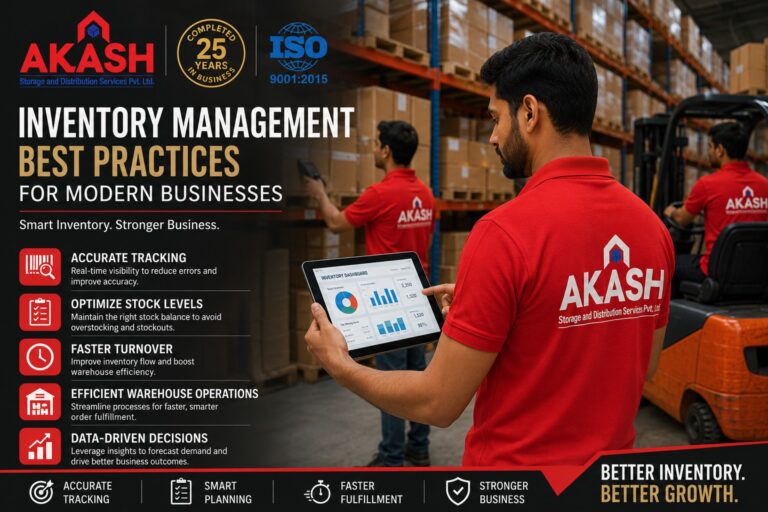
Implement a Warehouse Management System
Improve inventory visibility and operational control.
Optimize Warehouse Layouts
Reduce travel time and improve productivity.
Monitor Key Performance Indicators (KPIs)
Track metrics such as:
- Inventory accuracy
- Order fulfillment rates
- Storage utilization
- Delivery performance
Conduct Regular Inventory Audits
Maintain accurate inventory records.
Partner with Experienced Warehousing Providers
Leverage professional expertise and scalable infrastructure.
These best practices help businesses improve efficiency and strengthen supply chain performance.
Future of Warehousing and Supply Chain Efficiency
The future of warehousing will be driven by:
- Artificial Intelligence (AI)
- Internet of Things (IoT)
- Automation
- Robotics
- Predictive Analytics
These technologies will provide:
- Greater inventory visibility
- Faster decision-making
- Improved operational efficiency
- Enhanced customer experiences
Businesses that embrace innovation will be better prepared to compete in an increasingly dynamic marketplace.
Conclusion
Warehousing is a critical driver of supply chain efficiency. By improving inventory visibility, reducing costs, enhancing order fulfillment, and supporting customer satisfaction, efficient warehousing creates significant value for businesses.
Modern warehouses are no longer just storage facilities—they are strategic assets that contribute directly to operational excellence and business growth.
Organizations that invest in warehousing solutions and best practices will build stronger, more resilient supply chains capable of meeting future challenges and opportunities.
Improve Your Supply Chain with Akash Storage
Akash Storage & Distribution Services Pvt. Ltd. provides professional warehousing, inventory management, and distribution solutions designed to enhance supply chain efficiency and support business growth.
Contact us today to discover how our warehousing expertise can help optimize your supply chain operations.