If you're collecting quotes for a 3PL customer self-service portal, you've probably noticed the frustrating pattern: vendors quote a vague "setup fee," hide the per-client charges, and stay silent on what usage actually costs once your order volumes climb. Comparing two proposals becomes guesswork, and the real bill only surfaces after you've signed. That opacity isn't accidental — it makes competing offers hard to judge side by side.
This article fixes that. We break down what a self-service portal genuinely costs in India in 2026 — across one-time setup, per-tenant (per-client) licensing, and usage-based billing tiers — all in transparent INR figures. You'll see which line items are fixed, which scale with volume, and which questions to ask before you hire, so you can read any quote with confidence.
Key takeaways
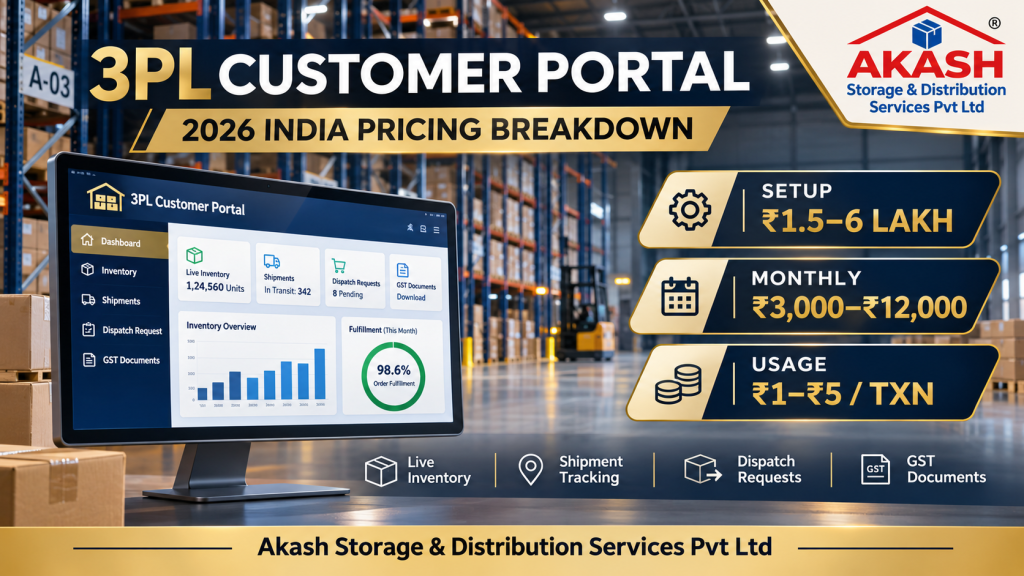
- A credible India 2026 quote separates three cost layers: one-time setup (₹1.5–6 lakh), per-tenant monthly subscription (₹3,000–₹12,000), and usage-based billing (₹1–₹5 per transaction over allowance).
- A warehouse customer portal lets clients self-serve inventory, order tracking, dispatch requests and GST documents instead of emailing or calling operations.
- Deflecting routine queries can save a mid-sized 3PL roughly ₹1 lakh a month, often paying back the portal within the first year.
- Insist on itemised pricing, clean multi-tenant data isolation, real-time integrations and GST-compliant billing before hiring any vendor.
What Is a Customer Self-Service Portal in Logistics?
A customer self-service portal in logistics is a secure, web-based dashboard where a 3PL's clients manage their own warehouse and dispatch activity without emailing or calling an operations desk. Instead of waiting for someone to reply with a stock figure or a delivery status, the client logs into a warehouse customer portal and sees the answer instantly. Globally, close to 70% of customers attempt self-service before seeking help, and logistics buyers in India increasingly expect the same.
How It Differs From Email-Based Support
Email support is reactive, serial and slow — each query waits in a queue, and the client has no visibility between replies. A 3PL client dashboard flips that model: data flows directly from the warehouse management system, so information is live, accurate and available 24/7. It replaces dozens of "where is my order?" and "what's my stock?" emails with a single screen.
The Core Jobs It Does
- Online order tracking logistics: real-time status of every outbound order, from picking to proof of delivery, including GPS-based transport visibility.
- Inventory portal: live stock at lot, bin, batch and expiry level, with FIFO/FEFO visibility per client.
- Self-service dispatch request: clients raise dispatch orders and advance shipping notices (ASNs) directly, instead of phoning the warehouse.
- Documents and billing: on-demand access to GRNs, LRs, PODs, GST invoices and usage reports.
Understanding these jobs matters because they drive the customer self-service portal cost and pricing decisions covered next — what you pay depends on which of these capabilities you actually need.
Features Every Warehouse Client Dashboard Should Have
Before you evaluate customer self-service portal cost or pricing, be clear on what a serious warehouse customer portal must include. In 2026, self-service is no longer a nicety — research shows close to 70% of customers attempt self-service before contacting support source. For a 3PL in India, these five modules separate a usable 3PL client dashboard from a glorified status page.
Live inventory portal
An inventory portal should show real-time stock at lot, bin, batch and expiry level, with FIFO/FEFO visibility and point-in-time snapshots. Clients storing pharma, FMCG or food in ambient, cold or bonded zones need to see exactly what is available before they commit to a sale.
Online order tracking
Online order tracking logistics ties inbound ASNs, picks, QA checks and dispatch to live GPS. A client in Pune should be able to follow a consignment moving to a Mumbai distributor without a single phone call to your operations desk.
Self-service dispatch request
A self-service dispatch request lets clients raise outbound orders directly — specifying SKUs, quantities, delivery address and vehicle type — which flows straight into your pick-pack-dispatch queue. This cuts email back-and-forth and reduces order errors.
Reporting and documents
Expect downloadable reports plus a document library holding GRNs, LRs, PODs and GST-compliant invoices. Good reporting covers stock ageing, throughput and usage-based billing clarity.
Multi-tenant access controls
Scoped, multi-tenant access ensures each client sees only their own data, with role-based permissions for their staff. For any customer self-service portal company in India, this isolation is non-negotiable — it protects confidentiality and underpins trust across your entire client base.
Five Must-Have Portal Modules
- Live inventory portal with lot, bin, batch and expiry visibility
- Online order tracking tied to live GPS
- Self-service dispatch request flowing into pick-pack-dispatch
- Reporting and document library (GRN, LR, POD, GST invoices)
- Multi-tenant access controls with role-based permissions
What a 3PL Customer Portal Actually Costs in India (2026 INR Breakdown)
Pricing for a warehouse customer portal in India rarely fits one number, and that is exactly why quotes are hard to compare. A credible proposal separates three cost layers: a one-time setup fee, a recurring per-tenant subscription, and usage-based charges that scale with activity. Reading a quote line by line against these three buckets is the fastest way to spot padding or hidden extras.
One-time setup (build and onboarding)
This covers configuration of your 3PL client dashboard, tenant provisioning, branding, integration with your WMS and transport systems, and data migration. For a standard multi-tenant inventory portal, expect ₹1.5 lakh to ₹6 lakh depending on how many integrations (ERP, GST e-invoicing, GPS tracking) are wired in. Heavily customised online order tracking logistics flows, custom document templates (GRN/LR/POD) or bonded-warehouse compliance screens push this toward the upper band.
Per-tenant monthly subscription
Most customer self-service portal pricing in India is billed per client tenant per month, since each of your customers gets a scoped dashboard with live inventory and self-service dispatch request capability. Typical ranges run ₹3,000 to ₹12,000 per tenant per month, with lower per-seat rates as your tenant count grows. A small 3PL onboarding five clients might budget ₹25,000–₹40,000 monthly; a larger operator with 40+ tenants negotiates volume slabs. Confirm whether GST (18%) is included or added on top.
Usage-based billing tiers
Variable charges track real throughput — orders processed, ASN inbound notices, API calls, SMS/email notifications, cold-chain IoT sensor data, and document storage. These are usually tiered: a bundled allowance (say, 5,000 order events) with overage at ₹1–₹5 per transaction beyond it.
When comparing a customer self-service portal company in India, insist on all three layers written out separately. India hosts 641 customer self-service companies, the second-largest pool globally source, so you have real leverage to demand transparent, line-item pricing.
Three Cost Layers of a Portal Quote
| Cost layer | What it covers | Typical INR range |
|---|---|---|
| One-time setup | Configuration, integrations, branding, data migration | ₹1.5 lakh to ₹6 lakh |
| Per-tenant subscription | Scoped dashboard per client, billed monthly | ₹3,000 to ₹12,000 per tenant/month |
| Usage-based billing | Orders, ASN, API calls, notifications, storage | ₹1 to ₹5 per transaction over allowance |
How Customers Track Orders and Raise Dispatch Requests Online
A modern warehouse customer portal turns everyday logistics questions — "Where is my stock?" and "When does it ship?" — into self-service actions that clients handle themselves, without emailing or calling your operations desk. With close to 70% of customers now attempting self-service before contacting support, a well-designed 3PL client dashboard directly reduces inbound queries. Here is what the live workflow actually looks like inside ASDSPL's platform.
From Login to Live Inventory
The client logs into a multi-tenant, scoped dashboard that shows only their stock. Online order tracking in logistics starts here: live inventory down to lot, bin, batch and expiry, with FIFO/FEFO status and point-in-time snapshots. A Mumbai distributor can confirm available quantity before promising a buyer — no phone call needed. This inventory portal view is the single source of truth both sides trust.
Raising a Self-Service Dispatch Request
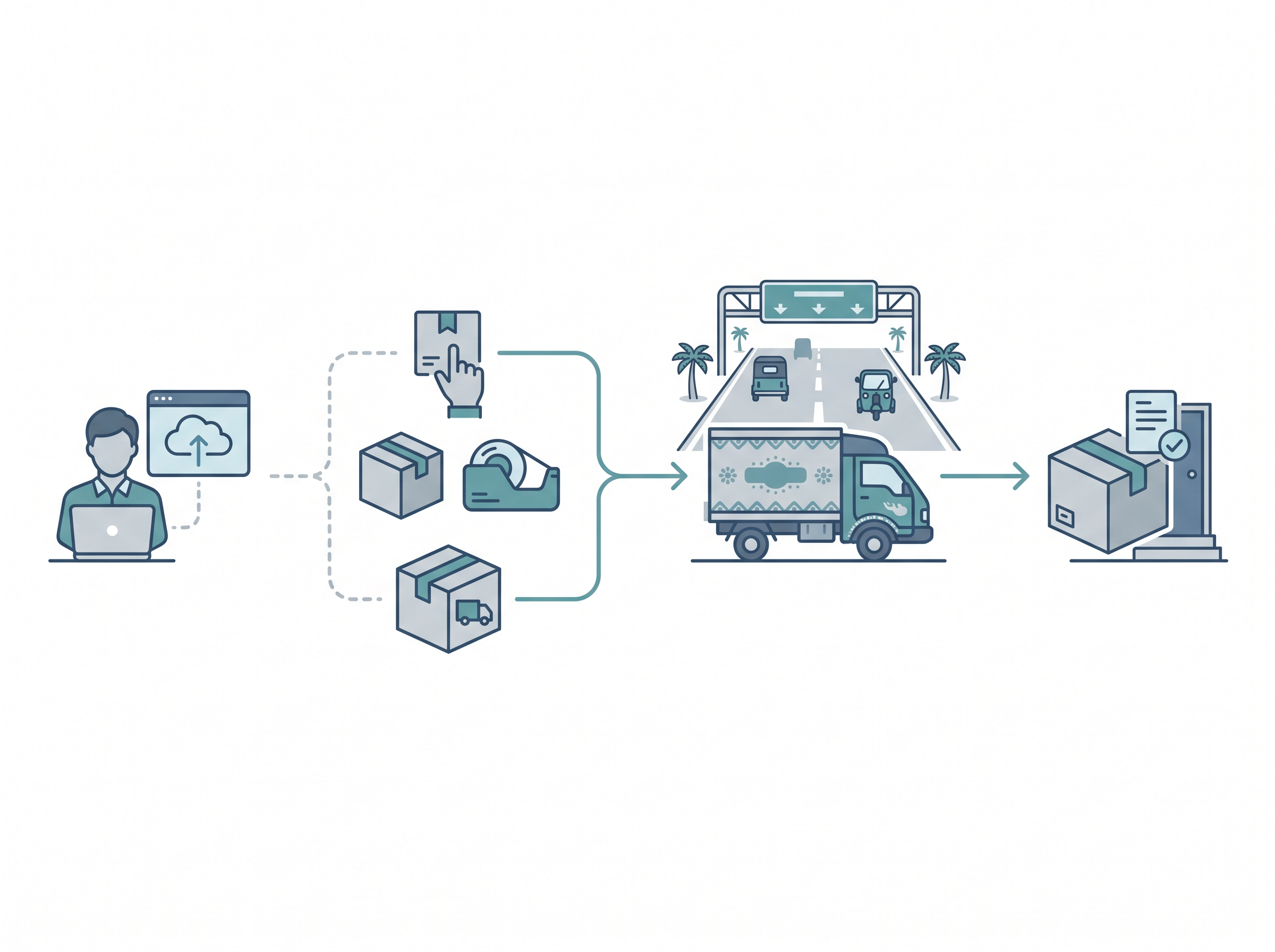
To ship, the client submits a self-service dispatch request directly from the dashboard — selecting SKUs, quantities, delivery address and preferred date. The request flows straight into warehouse execution: pick-pack, barcode scanning, QA checks, and route-optimised dispatch across corridors like Delhi–Jaipur or Chennai–Bengaluru.
Shipment Status Updates and Documents
As the order moves, the portal pushes shipment status updates — picked, packed, dispatched, in-transit (with live GPS), delivered. GRN, LR and POD documents land automatically in the document library alongside GST invoices. This closed loop is exactly what buyers evaluate when comparing any customer self-service portal company in India, and it shapes the pricing we break down next.
The Self-Service Dispatch Workflow
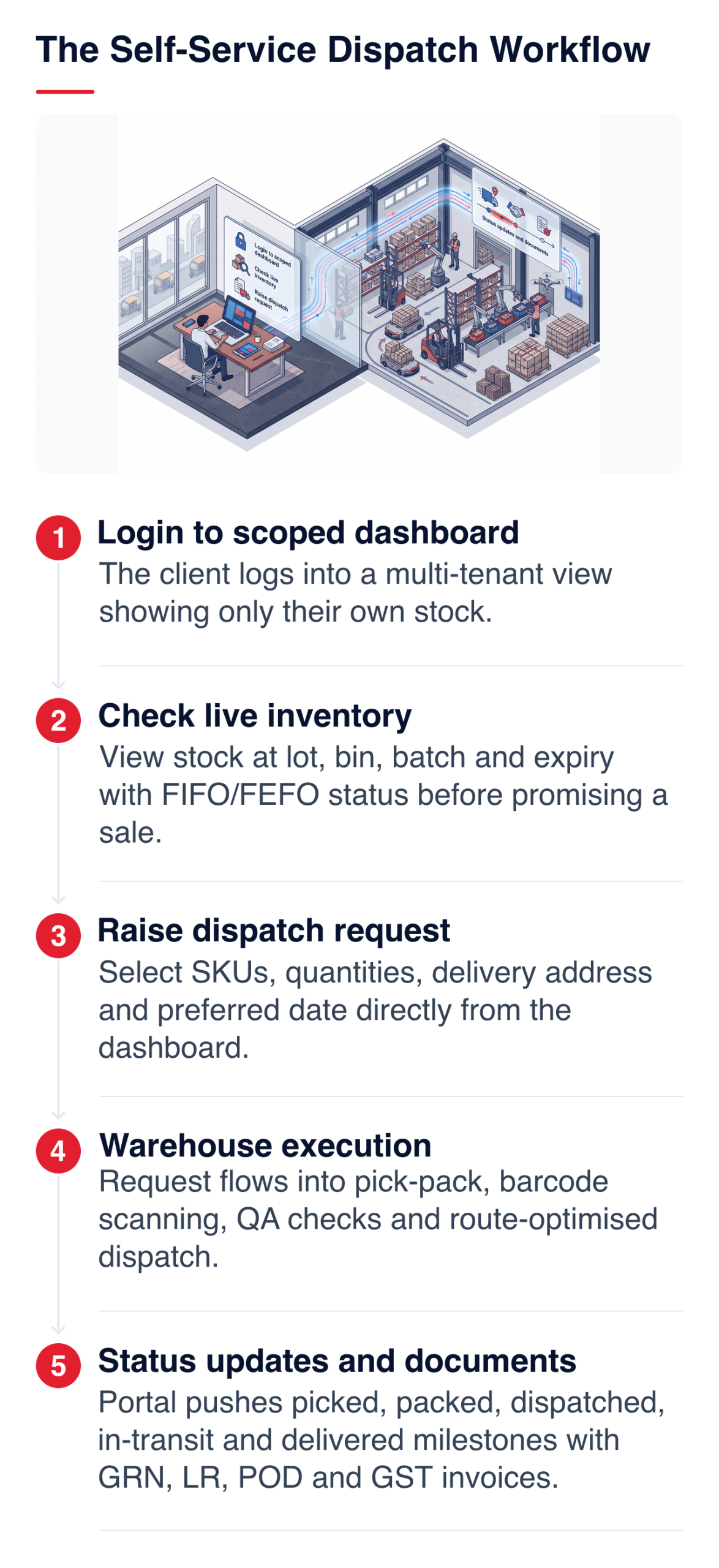
Text version of this process
- 1Login to scoped dashboardThe client logs into a multi-tenant view showing only their own stock.
- 2Check live inventoryView stock at lot, bin, batch and expiry with FIFO/FEFO status before promising a sale.
- 3Raise dispatch requestSelect SKUs, quantities, delivery address and preferred date directly from the dashboard.
- 4Warehouse executionRequest flows into pick-pack, barcode scanning, QA checks and route-optimised dispatch.
- 5Status updates and documentsPortal pushes picked, packed, dispatched, in-transit and delivered milestones with GRN, LR, POD and GST invoices.
How a Self-Service Portal Reduces Support Costs for a 3PL
For an Indian 3PL, every "Where is my shipment?" call and every manually answered email is unbilled labour. A warehouse customer portal absorbs that work by letting clients self-serve, so your operations team stops acting as a human query desk. With close to 70% of customers now attempting self-service before contacting support, demand for a well-built portal is already there — you simply need to meet it. source
Three cost levers that move the needle
- Deflected status calls: A 3PL client dashboard with online order tracking logistics and live inventory lets clients check stock and shipment status themselves, cutting repetitive phone traffic.
- Fewer manual emails: A document library (GRN/LR/POD), invoices and reports in an inventory portal replace back-and-forth email threads your team types out by hand.
- Faster dispatch cycles: A self-service dispatch request and ASN inbound notice flow straight into your operations platform, removing manual data entry and speeding turnaround.
A worked INR ROI example
Assume a mid-sized 3PL handling 40 client queries a day, each consuming 15 minutes of a coordinator earning ₹30,000/month (roughly ₹170/hour). That is 10 hours daily, or about ₹1.7 lakh a month in query handling. A portal that deflects 60% of those interactions saves close to ₹1 lakh monthly — over ₹12 lakh a year — before counting faster dispatch and fewer billing disputes.
Against typical customer self-service portal cost and customer self-service portal pricing in India, those recovered hours mean the platform often pays for itself within the first year. Choosing an experienced customer self-service portal company in India like ASDSPL ties the savings directly to your warehouse data.
Three Cost Levers That Move the Needle
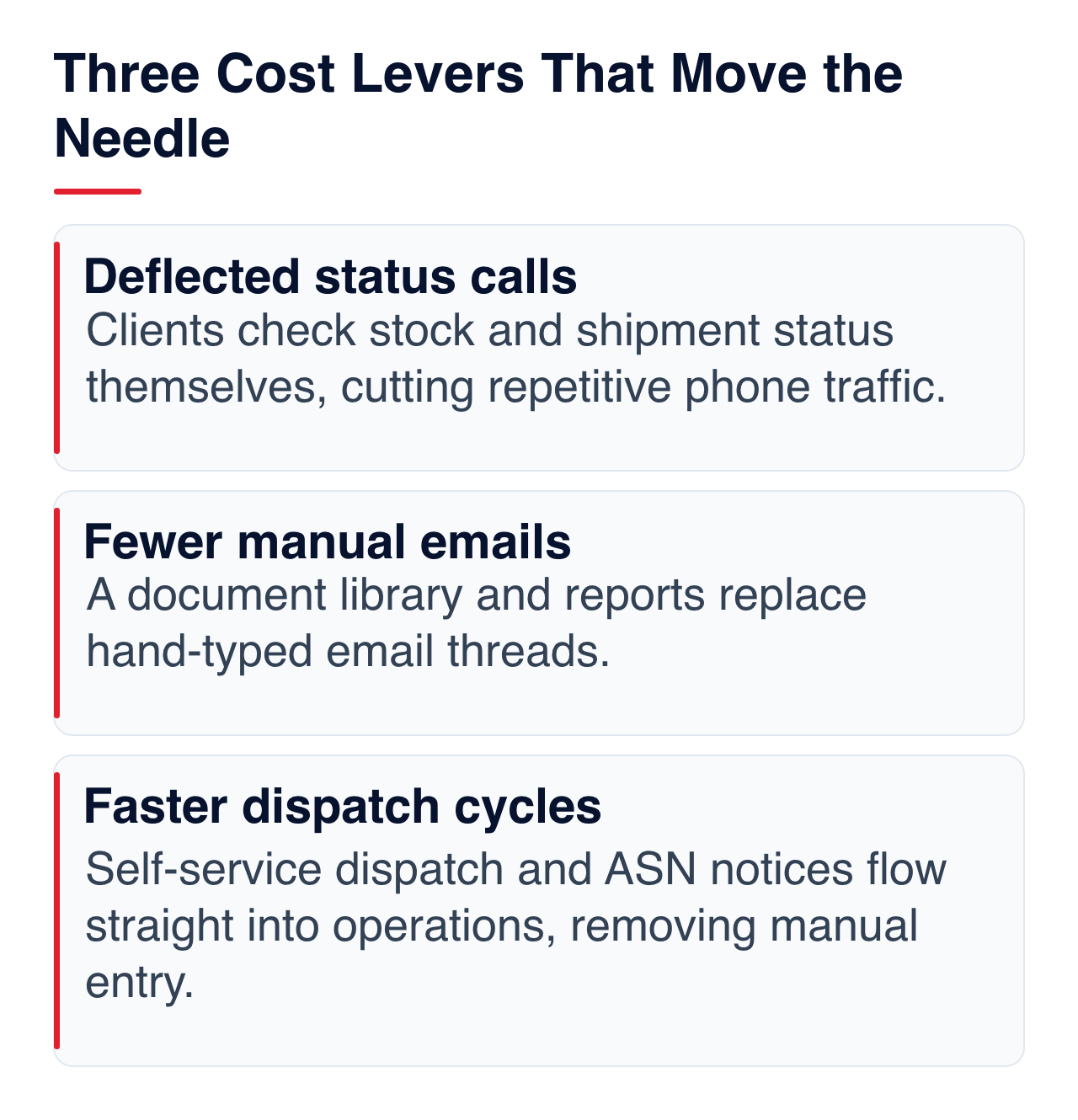
Text version of this infographic
- Deflected status calls. Clients check stock and shipment status themselves, cutting repetitive phone traffic.
- Fewer manual emails. A document library and reports replace hand-typed email threads.
- Faster dispatch cycles. Self-service dispatch and ASN notices flow straight into operations, removing manual entry.

Choosing and Hiring the Best Portal Company in India
Pricing tells you what a portal costs; your evaluation tells you whether it's worth it. Before signing with any customer self-service portal company in India, pressure-test the vendor on five dimensions that directly shape total cost of ownership.
Multi-tenant architecture that scopes data cleanly
A genuine multi-tenant platform isolates each client's data while running on shared infrastructure, which keeps per-tenant costs low and onboarding fast. Ask how a 3PL client dashboard enforces tenant boundaries, so one customer never sees another's inventory portal or order history. Weak isolation is a security liability and an expensive re-architecture later.
Integrations with your existing stack
Your warehouse customer portal must sync with WMS, ERP, transport and accounting systems. Confirm whether online order tracking logistics data, ASN inbound notices and self-service dispatch requests flow in real time or via nightly batches. API availability, webhook support and the cost of custom connectors belong in the quote — not in a surprise change request.
GST-compliant billing built in
Usage-based 3PL billing in India means storage, handling and transport charges must carry correct GST treatment, HSN/SAC codes and compliant invoice formats. Verify the portal generates GST-ready invoices customers can download alongside GRN, LR and POD documents. Retrofitting compliance is costly and audit-risky.
Support and SLAs
With close to 70% of customers attempting self-service before contacting support source, your portal becomes a frontline channel. Clarify response times, escalation paths, onboarding assistance and whether support is India-based and available in Asia/Kolkata hours.
Pricing transparency
Insist on itemised customer self-service portal pricing: setup, per-tenant fees, integration costs, support tiers and any per-transaction charges. Vendors who hide customer self-service portal cost behind vague "enterprise" quotes usually bill most on extras. Clear pricing signals an operator confident in its value.
Conclusion
A customer self-service portal is no longer a luxury add-on — it is fast becoming the baseline expectation for 3PL clients in India who want live inventory, order tracking, documents and invoices without a single phone call. As this breakdown shows, costs vary widely depending on whether you build in-house, buy off-the-shelf, or partner with a 3PL that already runs the platform. The smartest path for most shippers is to avoid the capital outlay entirely and let a logistics partner carry the technology burden alongside the warehouse operations. If you want live visibility into your stock, dispatches and billing without building software yourself, talk to the ASDSPL team about a portal-backed warehousing setup.
Read Your Portal Quote With Confidence
Now that you can separate setup, per-tenant and usage costs, the next step is matching them to your own client count and order volumes. Share your requirements and we'll map a transparent, line-by-line INR breakdown for a multi-tenant customer self-service portal — so every figure in your quote is one you can actually compare.
FAQs
Frequently Asked Questions
What is a customer self-service portal in logistics?
It is a secure online dashboard where your 3PL clients log in to track orders, view inventory, raise dispatch requests, download invoices, and check real-time stock across warehouses. Instead of emailing or calling your operations team, clients self-serve 24/7. Research shows nearly 70% of customers now attempt self-service first, making it a standard expectation in Indian logistics.
How much does a 3PL customer portal cost in India?
Pricing varies widely by scope. Basic branded portals with order tracking and reports typically start around ₹3-6 lakh as a one-time build, while mid-tier portals with inventory sync and dispatch workflows run ₹8-15 lakh. SaaS or subscription models range from ₹25,000 to ₹1 lakh per month, depending on user count, integrations, and support. GST applies additionally.
What features should a warehouse client dashboard have?
Prioritise real-time inventory visibility, order and dispatch tracking, invoice and GST document downloads, SKU-level stock reports, and multi-user access with role controls. Add a knowledge base, ticket raising, and proactive notifications for delays. Guest-mode public tracking and mobile responsiveness matter too. A clean, searchable interface ensures clients actually use it rather than reverting to phone calls.
How do customers track orders and dispatches online?
Clients log into the portal and view live order status pulled from your WMS or TMS via API integration. They see dispatch dates, vehicle details, delivery confirmations, and ePOD documents. Automated SMS or email alerts notify them of key milestones. Many portals also offer a public tracking link so end recipients can check status without logging in.
How does a self-service portal reduce support costs for a 3PL?
It deflects routine queries—stock levels, order status, invoice copies—that otherwise flood your ops team. Since around 70% of customers prefer solving issues independently, your staff handles fewer calls and emails, freeing them for exceptions. This cuts headcount pressure, speeds resolution, and improves client satisfaction, usually paying back the portal investment within the first year of operation.
Which is the best customer self-service portal company in India?
India has over 640 companies in the self-service space, so the right partner depends on your needs. Look for logistics-specific experience, WMS/TMS integration capability, clear INR pricing, and strong post-launch support. ASDSPL builds tailored 3PL portals for India-based clients, covering inventory visibility, dispatch tracking, and GST-ready reporting. Request a demo and compare roadmaps before committing.