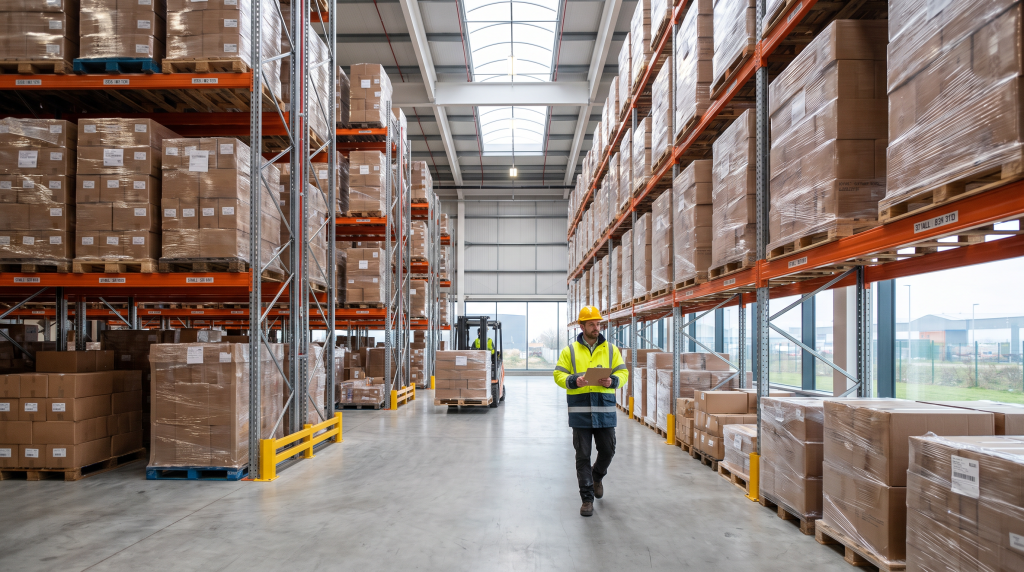
Choosing a 3PL warehousing partner in India often starts with a dozen glossy capability decks and ends in confusion. Every vendor claims pan-India coverage, real-time visibility and airtight compliance — yet the differences only surface after you've signed, when a GST-bonded shipment stalls or a cold-chain breach goes unreported. If you're actively vetting warehouse operators and need to separate genuine capability from sales talk, a gut-feel decision is a costly gamble.
This article turns the vague "how do I choose" question into a practical, scored evaluation framework. You'll get a buyer's checklist covering what matters most — regulatory and GST compliance, zone coverage (ambient, cold, hazmat, bonded, quarantine), portal visibility, and enforceable SLAs — plus the exact questions to ask and what to inspect during a site visit before you commit.
Key takeaways
- Break every 3PL quote into storage, handling, value-added services and minimum commitments so you compare like with like — the cheapest headline rate often hides the most add-ons.
- Match your goods to the right zone (ambient, cold, hazmat, bonded, quarantine) and insist the provider enforces per-client storage rules down to the bin and rack.
- Score shortlisted providers across compliance, zone coverage, portal visibility and SLAs rather than deciding on gut feel.
- Verify every claim on a site visit — racking, dock-to-stock flow, cold-chain graphs, live WMS and staffing — before you sign.
What Warehousing and Storage Actually Costs in India
Warehousing and storage pricing in India rarely comes as a single number. Quotes are built from several line items, and the cheapest headline rate often hides the most add-ons. Before you shortlist any warehousing and storage company in India, break every proposal into these components so you are comparing like with like.
Storage rates
Most 3PL warehouse storage is billed per pallet per month, though some providers use per-square-foot or per-cubic-metre rates for irregular cargo. Pallet storage is cleanest to benchmark because it normalises for cube. Expect higher rates for zone-aware warehousing — cold-chain, hazmat, bonded warehouse and quarantine space all command premiums over ambient Grade A storage, reflecting power, compliance and specialised handling. Rates also vary sharply by location, with Delhi NCR, Mumbai, Bengaluru and Pune corridors costing more than emerging Tier-2 hubs like Lucknow, Jaipur and Coimbatore.
Inward and outward handling
Handling is charged separately from storage, typically per pallet, per carton or per line on both inbound receiving (unloading, QC, putaway, GRN) and outbound dispatch (pick, pack, load). Confirm whether rates differ by unit type and whether palletisation, re-palletisation or labelling sit inside the handling rate or get billed again.
Value-added services (VAS)
Kitting, bundling, shrink-wrapping, batch and expiry capture, barcode scanning, returns processing and documentation are usually priced as VAS. These are where "hidden charges" accumulate, so ask for a rate card rather than a blended estimate.
Minimum commitments
Many operators set a minimum monthly storage or throughput commitment, or a fixed space reservation, regardless of actual usage. Clarify ramp-up periods, peak-season surcharges, GST treatment and whether billing is usage-based or slab-based.
A transparent provider gives you an itemised rate card and live portal visibility into storage, handling and VAS — so every invoice is traceable and benchmarkable.
Four Cost Drivers in an Indian Warehousing Quote
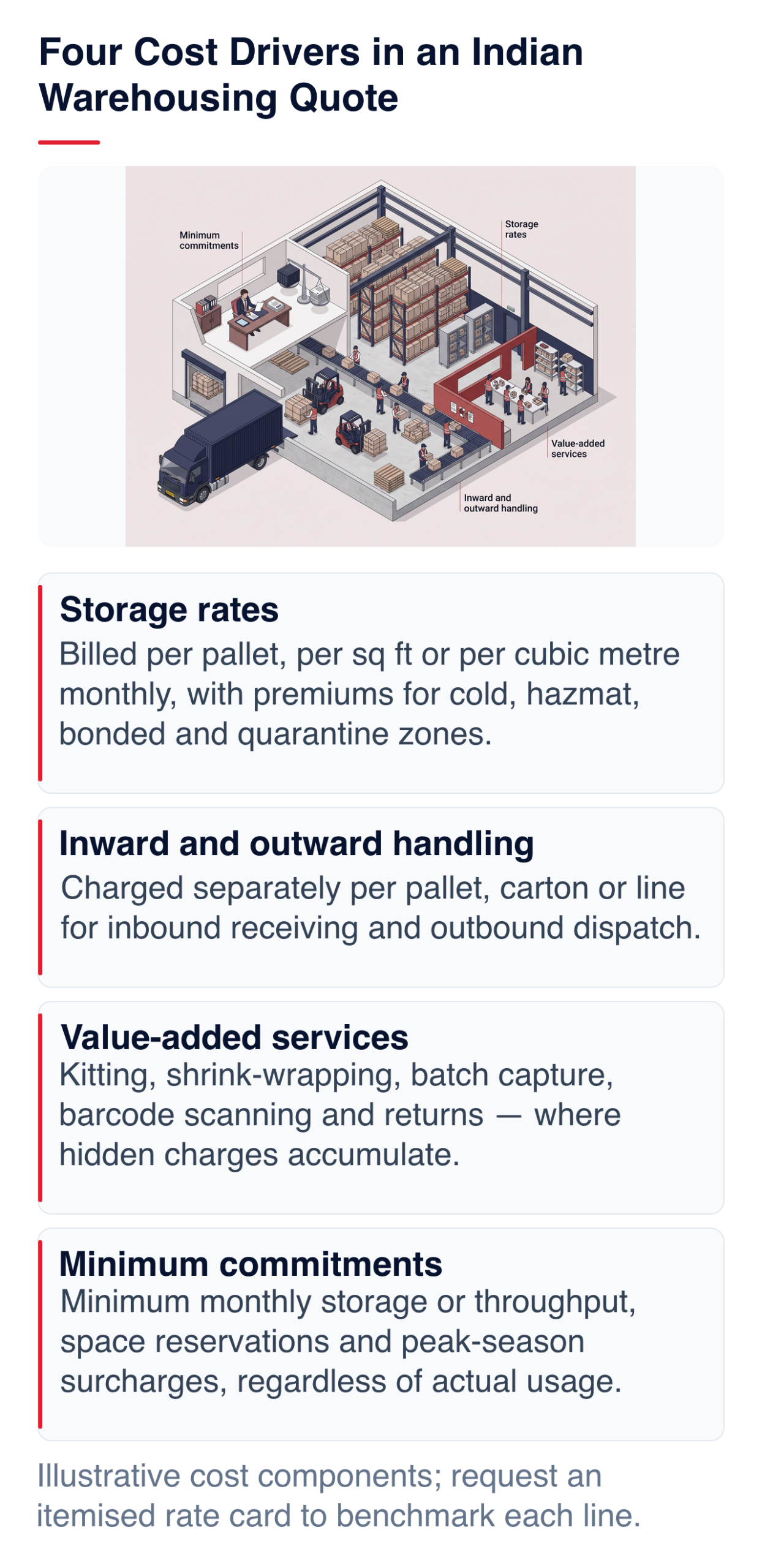
Text version of this infographic
- Storage rates. Billed per pallet, per sq ft or per cubic metre monthly, with premiums for cold, hazmat, bonded and quarantine zones.
- Inward and outward handling. Charged separately per pallet, carton or line for inbound receiving and outbound dispatch.
- Value-added services. Kitting, shrink-wrapping, batch capture, barcode scanning and returns — where hidden charges accumulate.
- Minimum commitments. Minimum monthly storage or throughput, space reservations and peak-season surcharges, regardless of actual usage.
Ambient, Cold, Hazmat and Bonded: Matching Storage Type to Your Goods
Not all stock belongs in the same shed. The right 3PL warehouse storage depends on what your product tolerates, what regulators demand, and where you want your duty liability to sit. Before you shortlist a warehousing and storage company in India, understand the four zone types so you pay for what you actually need — and nothing more.
Ambient storage
The workhorse of Indian logistics. Ambient (dry) warehouses handle FMCG, apparel, packaged foods, spares and e-commerce SKUs that need no temperature control. General warehousing led the market with 58.4% of occupancy and spend in 2026 source. Expect racked pallet storage, barcode putaway and FIFO/FEFO rotation. This is your lowest-cost tier on any warehousing and storage pricing sheet.
Cold storage
Pharma, dairy, frozen foods, fresh produce and vaccines require temperature-controlled zones — typically chilled (2–8°C) or frozen (below -18°C). Insist on IoT cold-chain monitoring with client-facing temperature graphs, because a single excursion can condemn a whole batch. Cold-chain carries higher warehousing and storage cost than ambient due to energy and compliance overheads.
Hazmat storage
Chemicals, paints, aerosols, lithium batteries and flammables need licensed hazmat zones with fire suppression, bunding, segregation and statutory approvals. Never let these share space with food or pharma — zone-aware warehousing that enforces per-client storage rules is what keeps you compliant.
Bonded warehouse and duty deferment
A bonded warehouse is a Customs-licensed facility where imported goods sit without immediate payment of customs duty and IGST. You pay duty only when goods clear for home consumption — or avoid it entirely on re-export. For importers with slow-moving stock, high duty value, or re-export plans, this frees up working capital significantly. If your imports clear and sell quickly, bonded status may add paperwork without real benefit.
Match the goods to the zone, and the warehousing services India provider to both.
Matching Storage Zone to Your Goods
| Zone | Typical goods | Key requirement |
|---|---|---|
| Ambient | FMCG, apparel, packaged foods, spares, e-commerce SKUs | Racked pallet storage with FIFO/FEFO rotation |
| Cold | Pharma, dairy, frozen foods, fresh produce, vaccines | Chilled (2–8°C) or frozen (below -18°C) with IoT monitoring |
| Hazmat | Chemicals, paints, aerosols, lithium batteries, flammables | Licensed zones with fire suppression, bunding and segregation |
| Bonded | Imported goods with deferred duty or re-export plans | Customs-licensed facility with current bonding status |
Zone-Aware Warehousing and Where India's Demand Is Concentrated
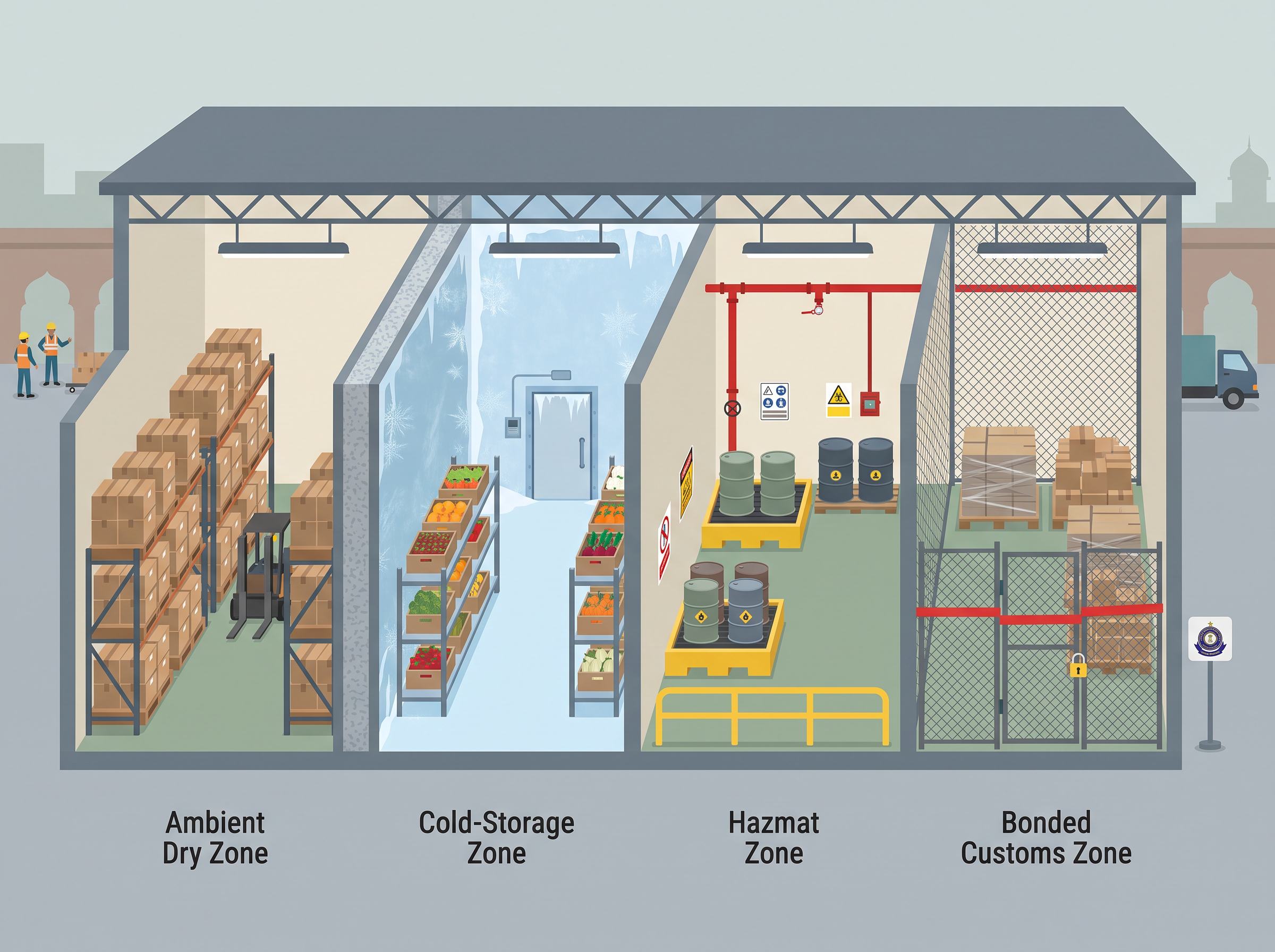
Zone-aware warehousing means a single facility is engineered as distinct, rule-governed storage environments — ambient, cold, hazmat, bonded and quarantine — rather than one undifferentiated shed. Each zone enforces its own storage conditions, compliance requirements and handling rules, so a batch of temperature-sensitive pharma, a pallet of FMCG and import stock awaiting customs clearance can sit in the same campus without cross-contamination or regulatory risk. For buyers evaluating warehousing services in India, this is the baseline: ask whether a provider separates pallet storage by zone, runs a bonded warehouse for duty-deferred imports, and enforces per-client storage rules down to the bin and rack.
Why multi-node networks cut time and cost
A single central warehouse forces long outbound legs to every customer. A zone-aware, multi-node network positions stock closer to demand, shrinking delivery windows and per-shipment transport cost. As delivery expectations tighten, fulfilment is moving nearer consumption centres — with Tier-2 and Tier-3 cities like Lucknow, Jaipur and Coimbatore emerging as growth points source. Distributing 3PL warehouse storage across nodes also smooths warehousing and storage cost, because usage-based pricing can be matched to where orders actually originate.
Which cities to prioritise
Demand is concentrated: Delhi NCR, Bengaluru and Hyderabad together account for roughly 60% of leasing, with 3PL alone making up about 35% of activity and e-commerce plus manufacturing driving around 60% of demand source. Prioritise these Tier-1 hubs for national coverage, then layer in emerging Tier-2 nodes — Lucknow, Jaipur, Coimbatore — to reach regional consumers faster. With India's Grade A stock now past 250 million sq ft source, insist on compliant facilities in each node you shortlist.
The Scored Evaluation Framework: Compliance, Coverage, Visibility and SLAs
Gut feel is a poor way to pick a warehousing and storage company in India. Instead, score each shortlisted 3PL on four weighted dimensions, then compare totals side by side. A practical split assigns roughly 30% to compliance, 25% to zone coverage, 25% to portal visibility and 20% to SLAs — adjust the weights to match your cargo and risk profile.
Licences and compliance (30%)
Verify GST registration, fire NOC, pollution clearances, and valid labour and factory licences before anything else. If you move imported goods, confirm the operator runs a genuine customs-bonded warehouse with current bonding status. For pharma or food, check cold-chain licences and FSSAI or drug-licence coverage. Score higher for Grade A compliant facilities, which now exceed 250 million sq ft of stock nationally and support higher throughput and audit-readiness, per Horizon Industrial Parks.
Zone coverage (25%)
Match the provider's zone-aware warehousing to your SKU mix — ambient, cold, hazmat, bonded and quarantine. Assess whether pallet storage racking, bin density and 3PL warehouse storage layouts suit your volumes. With fulfilment moving closer to consumption in Tier-2 cities like Lucknow, Jaipur and Coimbatore (Maersk), score multi-location networks that cut last-mile distance.
Portal visibility (25%)
Demand a live self-service portal: real-time stock, order tracking, ASN inbound notices, GRN/LR/POD documents and invoices. Lot, batch and expiry granularity with FIFO/FEFO enforcement should be visible, not promised. Deduct points for any operator relying on spreadsheets or next-day email reports.
SLA commitments (20%)
Insist on written SLAs for putaway time, dispatch accuracy, order turnaround and inventory accuracy, with penalties. Clarify warehousing and storage pricing and cost structure — usage-based storage, handling and transport charges — so the quote is comparable. Transparent warehousing and storage cost models score highest; opaque bundled rates score lowest.
Weighted Scoring Dimensions
| Dimension | Weight | What to verify |
|---|---|---|
| Licences and compliance | 30% | GST registration, fire NOC, pollution clearances, bonding and cold-chain licences |
| Zone coverage | 25% | Zone-aware warehousing matched to your SKU mix and multi-location reach |
| Portal visibility | 25% | Live stock, order tracking, ASN, GRN/LR/POD and lot/batch/expiry granularity |
| SLA commitments | 20% | Written SLAs with penalties and transparent usage-based pricing |
The Site Visit Checklist: What to Inspect Before You Sign
A polished proposal means little until you walk the floor. With 3PL accounting for roughly 35% of warehouse leasing demand in India, providers have become skilled at selling capacity — so your job on site is to verify claims, not admire them. Use the visit to pressure-test racking, flow, safety, systems and staffing against what the quote promised.
Racking and storage zones
Check that pallet storage racking is rated, certified and not visibly overloaded or damaged. For zone-aware warehousing, ask to see physically separated ambient, cold, hazmat, bonded and quarantine areas. A genuine bonded warehouse will have Customs documentation and sealed access — confirm it, don't assume it. Cold zones should show live temperature graphs, not just a thermostat on the wall.
Dock-to-stock flow
Follow a shipment from the dock inward. How long does goods receiving, batch/expiry capture and putaway actually take? Slow dock-to-stock inflates your effective warehousing and storage cost because inventory sits unsellable. Watch for barcode scanning at inbound and QA checks, not manual registers.
Safety and compliance
Look for fire suppression, clear aisles, marked emergency exits, trained forklift operators and visible safety signage. Grade A compliance matters when your goods or insurance depend on it.
WMS screens
Ask the operator to open the live WMS and show lot, bin and batch-level stock, FIFO/FEFO enforcement and a real-time snapshot. Then log into the client portal yourself — dashboards, order tracking, GRN/LR/POD documents and invoices should all be real and current.
Staffing
Check headcount against stated throughput, shift coverage and supervisor presence. Thin staffing is where service-level promises quietly break.
Finally, tie observations back to warehousing and storage pricing: confirm the quoted rates match the infrastructure, zones and service levels you actually saw.
On-Site Verification Checklist
- Confirm pallet racking is rated, certified and not overloaded or damaged
- Verify physically separated ambient, cold, hazmat, bonded and quarantine zones
- Check cold zones show live temperature graphs, not just a wall thermostat
- Confirm the bonded warehouse has Customs documentation and sealed access
- Time the dock-to-stock flow from receiving to putaway
- Inspect fire suppression, clear aisles, marked exits and trained forklift operators
- Log into the live WMS and client portal to see lot, bin and batch-level stock
- Check headcount, shift coverage and supervisor presence against stated throughput

Red Flags, Contract Terms and Shortlisting Your Final Partner
You have vetted three or four contenders. Now comes the hardest part — turning a shortlist into one accountable partner. The decision rests as much on the fine print as on the facility tour, so read contracts as carefully as you walk the floor.
Warning signs to take seriously
- Vague or verbal warehousing and storage pricing — a credible 3PL warehouse storage provider gives itemised, usage-based rates for pallet storage, handling, inbound/outbound and transport, not a single opaque monthly figure.
- No live inventory portal or real-time stock visibility. If you cannot see your goods at lot, bin and batch level, you are trusting a spreadsheet.
- Missing compliance for your zone — ask to see bonded warehouse licences, hazmat clearances and cold-chain IoT logs before you commit. Zone-aware warehousing claims should be verifiable on the day.
- Reluctance to share references from current India clients, or churn they won't explain.
Contract terms that protect you
Scrutinise the liability cap. Many warehousing and storage company in India contracts cap liability at a low multiple of monthly fees — inadequate if you store high-value pharma or electronics. Negotiate caps against actual inventory value and insist on named insurance cover. Pin down the exit clause: notice period (ideally 60–90 days), stock-retrieval timelines, final reconciliation, and who bears exit transport cost. Confirm GST treatment, SLA penalties for pick accuracy and dispatch delays, and annual escalation limits on warehousing and storage cost.
Choosing one
Score each contender on compliance, transparency, technology and cultural fit. The right warehousing services India partner is the one that answers hard questions plainly and puts those answers in writing.
Conclusion
Choosing the right 3PL partner comes down to disciplined shortlisting and a rigorous site visit — not just comparing rate cards. Match the provider's zone capabilities (ambient, cold, hazmat, bonded, quarantine) to your actual goods, verify inventory accuracy at lot, batch and expiry level, and insist on live visibility through a proper client portal before you sign. Walk the floor, check cold-chain monitoring and QA records firsthand, and confirm GST-compliant documentation and transparent, usage-based billing. The best fit is a partner whose systems, zones and service levels scale with your business across India's key corridors. If you're ready to evaluate a 3PL against this checklist, book a facility walkthrough and see the operation for yourself.
Ready to Compare Warehousing on Real Numbers?
Now that you know how to score zone coverage, compliance and SLAs, the next step is seeing it in practice. Ask for an itemised rate card and a walkthrough of ambient, cold, hazmat, bonded and quarantine zones with live portal visibility — so every invoice stays traceable and every claim is something you can actually inspect.
FAQs
Frequently Asked Questions
How do I choose a 3PL warehousing company in India?
Start by matching the 3PL's location network, storage types, and compliance to your product and demand corridors. Shortlist three to five providers, check certifications, technology (WMS, integrations), SLAs, and client references. Then conduct site visits to verify racking, safety, staffing, and housekeeping. Compare transparent pricing with GST clarity before signing, and confirm scalability for peak seasons.
How much does warehousing and storage cost in India?
Costs vary by city, grade, and storage type. Grade A ambient space typically runs higher than Tier-2 options, and you'll pay separately for inbound, storage per pallet or sq ft, pick-pack, and value-added services. Expect GST on 3PL charges. Request an itemised quote covering storage, handling, and minimum commitments, since blended per-order pricing can hide seasonal spikes.
What is zone-aware warehousing and how does it work?
Zone-aware warehousing places inventory closer to consumption clusters so orders ship from the nearest hub. With demand growing in Tier-2 cities like Lucknow, Jaipur, and Coimbatore alongside Delhi NCR, Bengaluru, and Hyderabad, a multi-node network shrinks delivery windows and freight costs. Your OMS or WMS routes each order to the optimal zone, improving speed and lowering last-mile spend.
What is a bonded warehouse and when do I need one?
A bonded warehouse lets you store imported goods without paying customs duty until they're cleared for domestic sale. You need one when importing in bulk, re-exporting, or deferring duty to manage cash flow. It's common for high-value or regulated goods. Confirm the 3PL holds valid customs bonding licences and can handle the compliance paperwork.
What is the difference between ambient, cold and hazmat storage?
Ambient storage holds goods at room temperature for dry products like apparel and electronics. Cold storage maintains chilled or frozen conditions for food, pharma, and perishables, requiring temperature monitoring. Hazmat storage handles flammable or hazardous materials under strict safety norms and licences. During site visits, verify the facility is certified and equipped for your specific product category.
Which cities have the best warehousing demand in India?
Delhi NCR, Bengaluru, and Hyderabad account for roughly 60% of leasing demand, backed by e-commerce and manufacturing. India expects 30-40 million sq ft of annual absorption in 2026, with 3PL driving about 35% of it. Tier-2 hubs like Lucknow, Jaipur, and Coimbatore are emerging fast as brands push fulfilment closer to consumers.
What should I check during a 3PL site visit?
Inspect racking stability, aisle widths, fire safety systems, and housekeeping standards. Review their WMS dashboard, inventory accuracy, and integration with your systems. Check loading docks, dock-to-stock time, and staff training. Ask about security, CCTV, and insurance coverage. Verify relevant certifications for your storage type and request KPIs and references from similar-category clients before deciding.

