You've asked three 3PLs for cold storage quotes and received three wildly different numbers — and none of them explain why. One charges per pallet, another per square foot, a third buries a "temperature surcharge" in the fine print. Before you can shortlist anyone, you need a straight answer to a simple question: what should cold chain storage actually cost per pallet in India in 2026?
This breakdown gives you real INR cost ranges segmented by temperature zone — frozen, chilled, and pharma-grade — so you can benchmark any quote with confidence. We'll also unpack the hidden charges most proposals quietly leave out, from handling and power escalation to monitoring and minimum-volume clauses, so the number you sign off on is the number you actually pay.
Key takeaways
- Cold chain storage in India is billed per pallet per month, with a broad 2026 baseline of roughly ₹1,200 to ₹4,500 depending on temperature zone, location, and service depth.
- The temperature band is the single biggest cost driver — frozen and pharma-grade space command a premium, while chilled and ambient-controlled sit lower.
- Hidden charges like handling, power surcharges, minimum-guarantee commitments, and compliance fees can push effective cost 25–40% above the headline per-pallet rate.
- Choose usage-based billing for seasonal or scaling volumes and dedicated fixed-space billing when utilisation stays consistently above roughly 75%.
Cold Chain Storage Cost Per Pallet in India: The 2026 Baseline
Before you compare quotes, it helps to understand what you are actually paying for. Cold chain storage in India is almost always billed on a per-pallet, per-month basis — a single, predictable unit that bundles the space your goods occupy, the energy to hold a target temperature, and the handling discipline that temperature-sensitive stock demands. As a broad 2026 baseline, buyers should expect roughly ₹1,200 to ₹4,500 per pallet per month, depending on the temperature zone, location, and service depth. Ambient and chilled storage sit at the lower end; deep-frozen and pharma-grade space command the premium.
What the per-pallet rate actually covers
A transparent cold storage 3PL rate typically folds in static storage, inbound receiving and putaway, and refrigerated warehousing overheads such as power, insulation and backup generation. Many providers quote storage separately from handling (in/out moves) and value-added services like FEFO rotation, batch/expiry capture and QA checks. Ask whether cold-chain monitoring is included or billed on top — a genuine temperature controlled warehouse should offer IoT sensor logging and client-facing temperature graphs as standard, not an add-on surprise.
Why the range is so wide
Three factors move the number most. First, the temperature band — holding −25°C costs far more in energy than +15°C. Second, location — metro-adjacent corridors like Mumbai, Delhi-NCR, Chennai and Bengaluru price higher than tier-2 hubs. Third, throughput and commitment — high-velocity, high-volume contracts earn better per-pallet economics than ad-hoc overflow storage.
Cold-chain storage and monitoring pricing also reflects compliance load: pharma and vaccine stock carries stricter documentation than frozen FMCG. Understanding this baseline lets you read the zone-by-zone breakdown that follows with a clear sense of what is fair — and what is padded.
Pricing by Temperature Zone: Frozen, Chilled, and Pharma Rates
Cold chain storage in India is priced per pallet per month, and the single biggest cost driver is the temperature band you need held. Deeper cooling means more energy, tighter insulation, and stricter monitoring — so rates climb as the thermometer drops. The indicative 2026 ranges below reflect typical organised refrigerated warehousing pricing across major corridors like Mumbai, Delhi-NCR, Chennai, and Hyderabad. Treat them as planning benchmarks; actual quotes shift with location, volume commitment, pallet dimensions, and dwell time.
Frozen Zone (−25°C to −18°C)
Used for ice cream, seafood, frozen meat, and ready-to-cook foods, frozen storage is the most energy-intensive band. Expect roughly ₹1,800–₹3,200 per pallet per month. The wide spread reflects power tariffs and whether you need blast-freezing capacity alongside holding.
Chilled Zone (0°C to 8°C)
The workhorse band for dairy, fresh produce, beverages, and processed foods typically runs ₹900–₹1,800 per pallet per month. Faster inventory turns and FEFO enforcement keep effective costs lower here, which is why high-velocity FMCG distribution concentrates in this zone.
Ambient-Controlled Zone (15°C to 25°C)
For confectionery, cosmetics, nutraceuticals, and shelf-stable goods that still need humidity and temperature stability, ambient-controlled space sits around ₹450–₹900 per pallet per month — a cost-efficient middle ground above plain ambient storage.
Pharma-Grade Zone (2°C to 8°C, plus −20°C and controlled room temperature)
Vaccines, biologics, and formulations demand validated mapping, redundant cooling, backup power, and audit-ready documentation. Pharma-grade storage commands a premium of roughly ₹2,500–₹5,000 per pallet per month, with ultra-low-temperature and narcotics-grade requirements pushing higher.
Across every band, continuous cold chain monitoring is now table stakes. A capable cold-chain storage and monitoring company in India such as ASDSPL bundles IoT sensors, client-facing temperature graphs, and alerting into the rate — protecting both product integrity and GST-compliant billing transparency.
Indicative 2026 Per-Pallet Rates by Temperature Zone
| Zone | Temperature Band | Typical Rate (per pallet/month) |
|---|---|---|
| Frozen | −25°C to −18°C | ₹1,800–₹3,200 |
| Chilled | 0°C to 8°C | ₹900–₹1,800 |
| Ambient-Controlled | 15°C to 25°C | ₹450–₹900 |
| Pharma-Grade | 2°C to 8°C, plus −20°C and CRT | ₹2,500–₹5,000 |
Hidden Charges Most Cold Storage Quotes Don't Show
The per-pallet rate you see on a cold chain storage India quote is rarely what you end up paying. Between handling, power and compliance line items, the effective cost of refrigerated warehousing often runs 25–40% above the headline figure. Knowing where these charges hide lets you compare cold storage 3PL providers on true landed cost, not just the sticker.
Handling and loading fees
Inbound putaway and outbound picking are usually billed separately from storage — often per pallet, per carton or per movement. Reefer loading and unloading attract their own rate because dock doors and staging must stay temperature-controlled while vehicles are worked. Ask whether handling is one-time or charged on every touch, and whether cross-docking is priced differently.
Power surcharge and fuel escalation
Running a temperature controlled warehouse at -25°C consumes far more electricity than ambient space. Many operators pass through a power surcharge or a quarterly escalation clause tied to state tariff revisions and diesel-backed generator use during outages. In long Indian summers, this variable can swing your monthly bill noticeably.
Minimum-guarantee commitments
Most contracts carry a minimum pallet or minimum revenue guarantee. If your actual stored volume dips below the committed floor, you still pay for the empty positions — a common surprise during seasonal troughs.
Compliance and monitoring charges
Cold-chain monitoring, IoT sensor data, temperature graphs, FSSAI and pharma audit documentation, and GRN/POD records may appear as a compliance or technology fee. GST applies on top of all the above. A transparent cold-chain storage and monitoring company in India should itemise these so your cold-chain storage and monitoring cost is fully visible before you sign.
Hidden Charges to Check Before You Sign
- Handling and loading fees billed separately from storage
- Reefer loading and unloading rates
- Power surcharge or quarterly fuel escalation clause
- Minimum pallet or minimum revenue guarantee
- Compliance, IoT monitoring and documentation fees
- GST applied on top of all line items
Usage-Based vs Fixed Monthly Billing: Which Model Fits You
Once you understand per-pallet rates by temperature zone, the next decision is how you want to be billed. Most cold chain storage in India is priced one of two ways, and choosing the wrong model can quietly inflate your cold-chain storage and monitoring cost by 20–30%.
Dedicated Fixed-Space Billing
Here you reserve a defined block of a temperature controlled warehouse — say 500 pallet positions in a frozen zone — and pay a flat monthly fee whether those positions are full or empty. The rate per pallet is typically lower, and you get guaranteed capacity during peak seasons. This suits businesses with stable, predictable volumes: frozen FMCG distributors, dairy brands, and pharma companies holding steady vaccine or formulation stock year-round. The trade-off is that you absorb the cost of idle space.
Usage-Based Per-Pallet-Per-Day Billing
With a cold storage 3PL like ASDSPL, you pay only for pallets actually stored, charged per day. There is no penalty for low months and no scramble for space in high ones. This fits seasonal agri-produce, e-commerce grocery, clinical-trial shipments, and new entrants testing demand. Refrigerated warehousing billed this way converts a fixed overhead into a variable cost that tracks revenue.
Which Model Fits You
As a rule, if your utilisation stays above roughly 75% consistently, dedicated space usually wins on unit economics. If volumes swing seasonally or you are scaling, usage-based pricing protects cash flow. Either way, insist on transparent cold chain monitoring — IoT temperature graphs and portal-level visibility — so you are paying for integrity, not just floor space.
Billing Models Compared
| Model | Best For | Trade-off |
|---|---|---|
| Dedicated Fixed-Space | Stable, predictable volumes like frozen FMCG, dairy and year-round pharma stock | You absorb the cost of idle space |
| Usage-Based Per-Pallet-Per-Day | Seasonal agri-produce, e-commerce grocery, clinical trials and new entrants | Converts fixed overhead into variable cost tracking revenue |
IoT Cold Chain Monitoring: How It Works and Cuts Spoilage
In a temperature controlled warehouse, a single undetected excursion can spoil an entire pallet of vaccines, dairy, or frozen seafood. IoT-based cold chain monitoring removes that blind spot by continuously tracking conditions instead of relying on a manual log checked twice a shift. For buyers comparing cold chain storage India options, this technology layer is often the difference between a warehouse that merely stores cold and a cold storage 3PL that actively protects product value.
How the system works
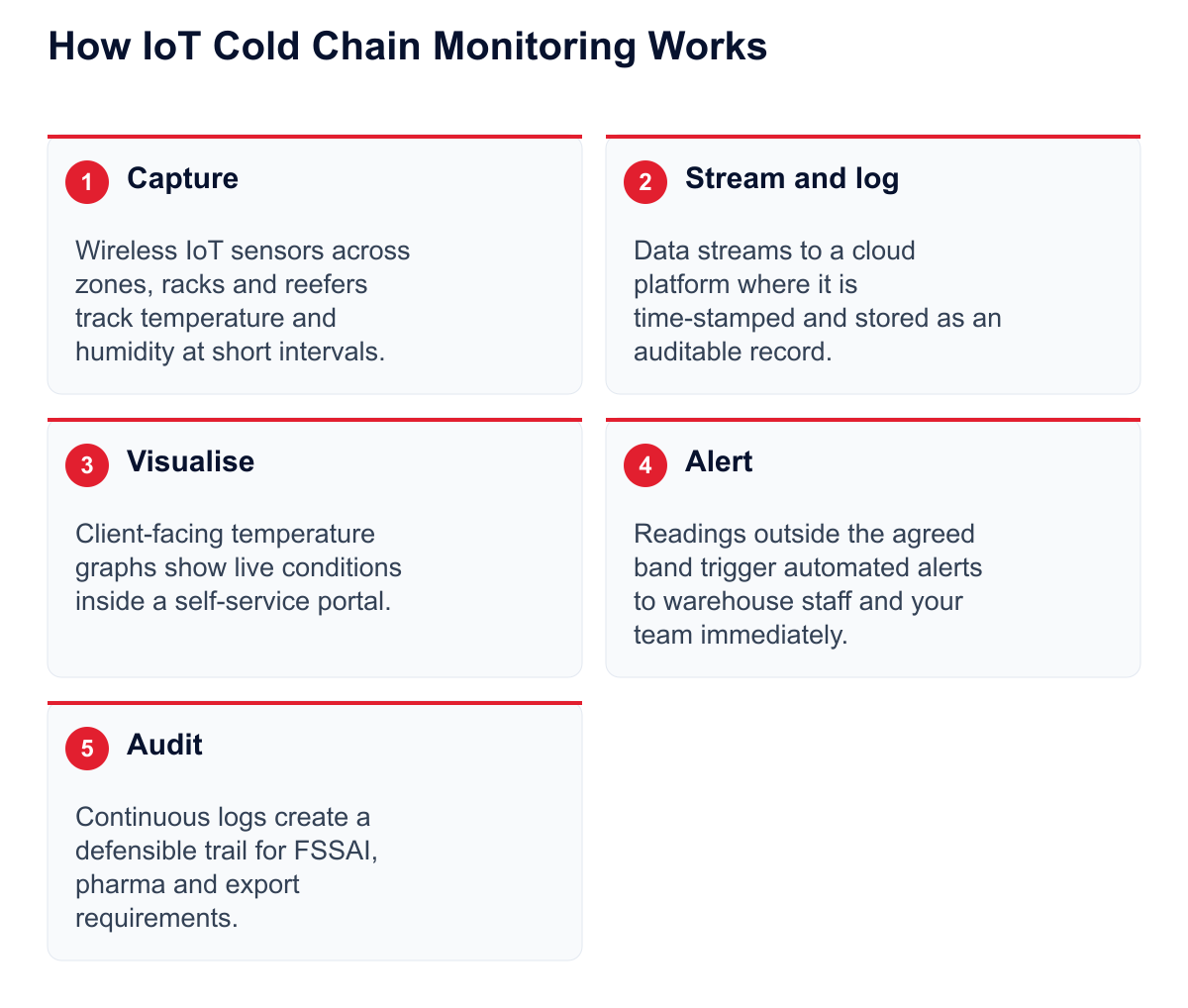
Wireless IoT sensors placed across zones, racks, and reefer vehicles capture temperature and humidity at short intervals. That data streams to a cloud platform, where it is time-stamped and stored as an auditable record. At ASDSPL, this feeds client-facing temperature graphs inside the self-service portal, so you see live conditions for your own stock without phoning the floor. The same approach is already proven in Indian operations — Rebel Foods, for instance, deployed real-time IoT sensor monitoring across its network to safeguard quality source.
Automated alerts prevent spoilage
When a reading drifts outside the agreed band for a product, the platform triggers automated alerts to warehouse staff and your team immediately — not hours later. Early warning means a failing compressor or a door left open gets fixed before stock crosses the damage threshold, directly reducing write-offs in refrigerated warehousing.
Compliance and dispute protection
Continuous logs create a defensible audit trail for FSSAI, pharma, and export requirements, and settle "was it cold the whole time?" disputes with evidence. This is why cold-chain monitoring increasingly shapes cold-chain storage and monitoring pricing: the sensor and dashboard layer is a modest line item against the spoilage and penalty risk it eliminates for a serious cold-chain storage and monitoring company in India.
How IoT Cold Chain Monitoring Works
- 1CaptureWireless IoT sensors across zones, racks and reefers track temperature and humidity at short intervals.
- 2Stream and logData streams to a cloud platform where it is time-stamped and stored as an auditable record.
- 3VisualiseClient-facing temperature graphs show live conditions inside a self-service portal.
- 4AlertReadings outside the agreed band trigger automated alerts to warehouse staff and your team immediately.
- 5AuditContinuous logs create a defensible trail for FSSAI, pharma and export requirements.
View process infographic
How to Choose a Cold Chain 3PL Company in India
Pallet pricing only matters if the provider can actually protect your product. Before you compare a cold-chain storage and monitoring cost quote, run every shortlisted cold storage 3PL through a practical capability checklist. The right partner protects margin twice — once through fair pricing, and again by preventing spoilage that no invoice ever shows.
Temperature range and zone flexibility
Confirm the warehouse holds stable temperatures across the zones you need — chilled (2–8°C), frozen (-18°C to -25°C) and deep-frozen for specific pharma or seafood lines. Zone-aware refrigerated warehousing that also offers ambient, bonded and quarantine space under one roof reduces handovers and cost.
Certifications and compliance
For food, insist on FSSAI licensing and HACCP-aligned processes; for pharma, look for GDP/WHO-GSP compliance, GST-registered bonded handling and batch-level documentation. FIFO/FEFO enforcement with lot, bin, batch and expiry tracking is non-negotiable for regulated goods.
Cold chain monitoring you can audit
Real-time cold chain monitoring is now standard among serious operators — Indian brands like Rebel Foods already deploy IoT sensor systems source. Ask for IoT sensors, client-facing temperature graphs, automated excursion alerts and exportable logs for audits — not just manual data loggers checked at dispatch.
Network and corridor reach
Match the provider's footprint to your distribution map — proximity to consumption hubs like Mumbai, Delhi-NCR, Bengaluru and Chennai, plus reefer transport with live GPS and route optimisation for last-mile integrity.
Visibility and billing transparency
A self-service portal showing live inventory, order tracking, GRN/LR/POD documents and usage-based invoices tells you the cold-chain storage and monitoring pricing is transparent. If you cannot see your stock and temperatures in real time, you are buying risk, not a service.
Conclusion
Cold chain storage costs in India vary widely by temperature zone — chilled, frozen and deep-frozen each carry different energy, equipment and compliance overheads that flow directly into your per-pallet rate. As this 2026 breakdown shows, the headline number is only part of the picture: handling charges, minimum commitments, FEFO discipline, IoT monitoring and dispatch efficiency all shape your true cost per pallet. The smartest move is to match your product's exact temperature requirement to the right zone, avoid over-cooling, and work with a 3PL that gives you transparent, usage-based billing and live visibility. If you want a clear per-pallet estimate for your products, reach out to ASDSPL for a tailored cold chain storage assessment.
Benchmark Your Cold Storage Quote With Confidence
Now that you know the 2026 per-pallet ranges and where hidden charges lurk, see how transparent cold-chain pricing should read. ASDSPL bundles IoT sensors, client-facing temperature graphs and alerting into the rate — across frozen, chilled and pharma-grade zones. Share your volumes and temperature band, and get a benchmarked quote with no buried surcharges.
FAQs
Frequently Asked Questions
How much does cold chain storage cost per pallet in India?
Cold chain storage in India typically ranges from ₹150 to ₹400 per pallet per day, depending on the temperature zone. Chilled storage (2°C to 8°C) sits at the lower end, while deep-frozen storage (-25°C and below) costs more due to higher energy use. Location, volume commitments, and value-added services also influence final pricing.
What temperature ranges do cold storage warehouses offer?
Indian cold storage warehouses generally offer four zones: ambient-controlled (15°C to 25°C), chilled (2°C to 8°C) for dairy and pharma, frozen (-18°C to -22°C) for meat and ice cream, and deep-frozen (-25°C and below) for vaccines and seafood. Each zone carries different energy costs, which directly affect per-pallet pricing.
What is IoT cold chain monitoring and how does it work?
IoT cold chain monitoring uses connected sensors to continuously track temperature, humidity, and location across storage and transit. Data flows to cloud dashboards in real time, and automated alerts flag any deviation instantly. Indian firms like TagBox serve clients such as Rebel Foods, helping prevent spoilage, maintain compliance, and create audit-ready temperature records.
How can real-time monitoring reduce cold chain spoilage?
Real-time monitoring detects temperature excursions the moment they happen, triggering alerts so staff can act before products spoil. Unlike basic data loggers that only reveal problems after the fact, continuous visibility across storage and transit protects perishables, reduces losses, and ensures regulatory compliance—critical for India's pharma, dairy, and frozen FMCG segments.
Is cold storage billing usage-based or fixed monthly?
Both models exist in India. Usage-based billing charges per pallet per day, ideal for seasonal or fluctuating inventory. Fixed monthly contracts suit businesses with steady, predictable volumes and often secure lower per-pallet rates. Many 3PL providers offer hybrid plans, combining a committed base volume with pay-as-you-go flexibility for overflow stock.
How do I choose a cold chain 3PL company in India?
Evaluate temperature-zone capabilities, IoT monitoring and real-time alerts, geographic coverage near your markets, and compliance credentials for pharma or food safety. Check pricing transparency, backup power reliability, and value-added services. Reviewing track records with established players like Stellar Value Chain or Brattle Foods, plus GST-compliant documentation, helps ensure a dependable partner.
